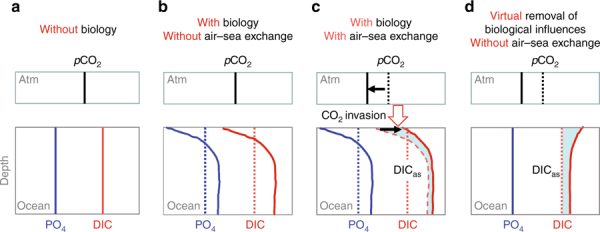
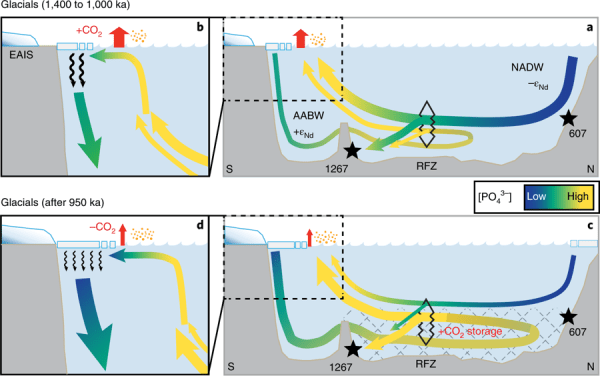
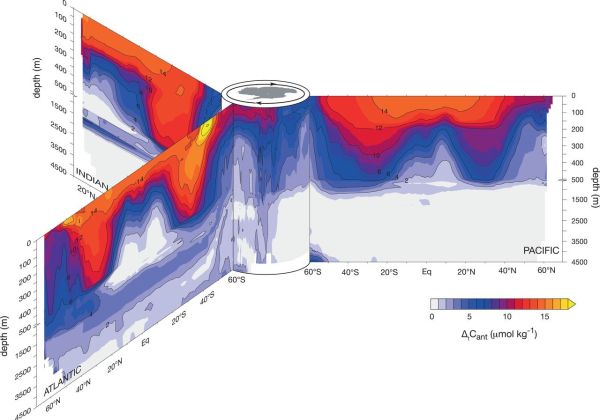
Oceans worldwide are undergoing acidification due to the penetration of anthropogenic CO2 from the atmosphere. The rate of acidification generally diminishes with increasing depth. Yet, slowing down of the thermohaline circulation due to global warming could reduce the pH in the deep oceans, as more organic material would decompose with a longer residence time. To... Continue Reading →
Meridional Overturning Circulation (MOC) in Europa?
This article appeared in Nature Geoscience in 2014 used a numerical model to hypothesize that a meridional overturning circulation (MOC) exists in the ocean beneath the icy surface of Jupiter's moon Europa. The geothermal heat generated from tidal flexing drives Europa's MOC, which carries heat toward the surface in the low latitudes then poleward. This study... Continue Reading →
Highlights of the findings of the U.S. global change research program climate science special report
This executive summary presents the Fourth National Climate Assessment (NCA4), an authoritative assessment of the science of climate change, with a focus on the United States. This represents the first of two volumes of the Fourth National Climate Assessment, mandated by the Global Change Research Act of 1990. https://science2017.globalchange.gov/chapter/executive-summary/
The central role of ocean dynamics in connecting the North Atlantic Oscillation to the extratropical component of the Atlantic Multidecadal Oscillation
The relationship between the North Atlantic Oscillation (NAO) and Atlantic sea surface temperature (SST) variability is investigated using models and observations. Coupled climate models are used in which the ocean component is either a fully dynamic ocean or a slab ocean with no resolved ocean heat transport. On time scales less than 10 yr, NAO... Continue Reading →
Arctic sea-ice decline weakens the Atlantic Meridional Overturning Circulation
The ongoing decline of Arctic sea ice exposes the ocean to anomalous surface heat and freshwater fluxes, resulting in positive buoyancy anomalies that can affect ocean circulation. In this study, we use an optimal flux perturbation framework and comprehensive climate model simulations to estimate the sensitivity of the Atlantic Meridional Overturning Circulation (AMOC) to such... Continue Reading →
The North Atlantic Oscillation as a driver of rapid climate change in the Northern Hemisphere
Pronounced climate changes have occurred since the 1970s, including rapid loss of Arctic sea ice, large-scale warming and increased tropical storm activity in the Atlantic. Anthropogenic radiative forcing is likely to have played a major role in these changes, but the relative influence of anthropogenic forcing and natural variability is not well established. The above... Continue Reading →
The role of Atlantic overturning circulation in the recent decline of Atlantic major hurricane frequency
Observed Atlantic major hurricane frequency has exhibited pronounced multidecadal variability since the 1940s. However, the cause of this variability is debated. Using observations and a coupled earth system model (GFDL-ESM2G), here we show that the decline of the Atlantic major hurricane frequency during 2005–2015 is associated with a weakening of the Atlantic Meridional Overturning Circulation... Continue Reading →