As of 2024, there are currently 70 permanent research stations from 29 countries scattered around the continent of Antarctica conducting important scientific research to better understand the Earth system and its changes due to human activity. In the Arctic, however, there are no such permanent research stations because there is no land in the Arctic.... Continue Reading →
The Labrador Current restricts the Arctic freshwater-induced weakening of the AMOC
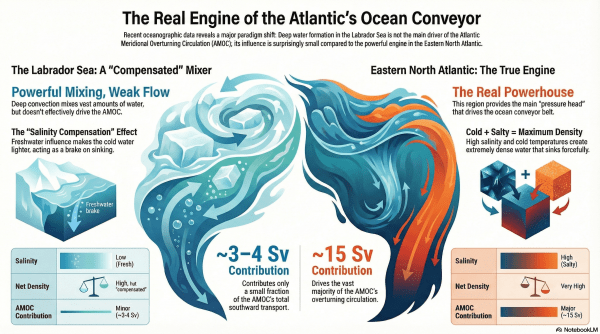
The Labrador Sea is one of the main regions where the surface Atlantic water loses its heat to the atmosphere (thus gets heavier) and sinks into the deep ocean, producing what's known as deep ocean convection that mainly drives the Atlantic Meridional Ocean Circulation (AMOC). It is also characterized by the Labrador Current, a strong... Continue Reading →
Geomagnetic correction of submarine cable measurement revealed no significant trend in the Gulf Stream transport since 1982
The Florida Current (FC) refers to the Gulf Stream across the Florida Straits between Florida and the Bahamas. Its volume transport has been measured continuously since 1982 using submarine cables across the Florida Straits at 27°N by NOAA's Atlantic Oceanographic and Meteorological Laboratory (AOML). A previous study (Piecuch and Beal, 2023) reported that the FC... Continue Reading →
AMOC collapse is unlikely in the near future
A new study published in Science (Zhou and McManus, 2024) reconstructed the land ice melting (or discharge) rate during the intermittent events of ice melting in the last glacial period (i.e., Heinrich events). The study showed that the present-day Greenland Ice Sheet melting rate (since the 1980s) is comparable to that during weak-to-moderate strength Heinrich events. This... Continue Reading →
Sustained ocean measurements at 34°S crucial for estimating the distance to an AMOC collapse
The Atlantic Meridional Overturning Circulation (AMOC) transports warm and salty upper ocean water to the subpolar North Atlantic where the upper ocean releases some heat to the atmosphere. Due to the surface cooling and the high salinity (i.e., salty), the upper ocean water becomes heavier and thus sinks down to the deep ocean and then... Continue Reading →
How did excessive Labrador Sea convection in the 1990s increase the AMOC?
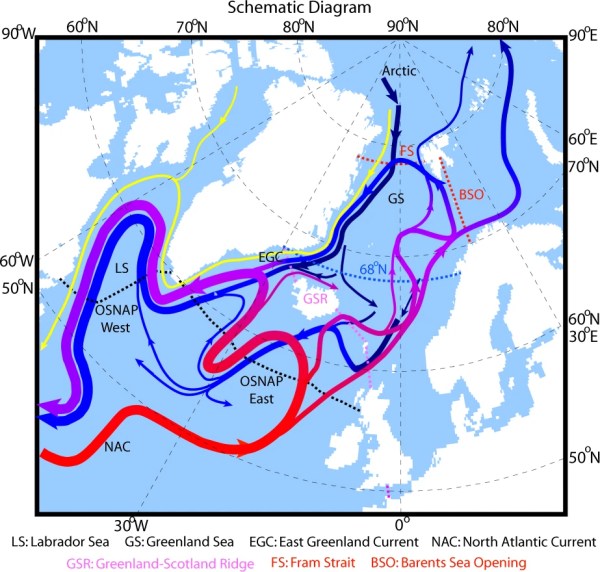
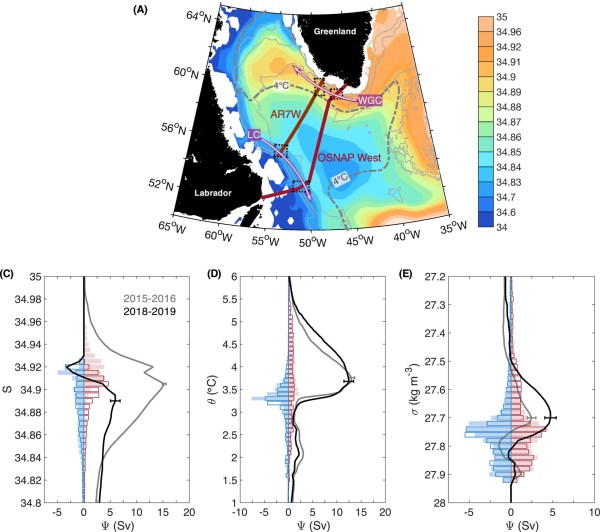
The Overturning in the Subpolar North Atlantic Program (OSNAP) observing system, which was launched in the summer of 2014 comprises an integrated coast-to-coast array of two sections: OSNAP West, extending from the southeastern Labrador shelf to the southwestern tip of Greenland, and OSNAP East, extending from the southeastern tip of Greenland to the Scottish shelf.... Continue Reading →
Is the AMOC shutting down soon?
The Atlantic Meridional Overturning Circulation (AMOC) is the Atlantic component of the global ocean conveyor belt, which is a large-scale ocean circulation system that connects the Arctic, Atlantic, Indian, and Pacific Oceans via the Southern Ocean. Predominantly driven by deep convection in the high-latitude North Atlantic Ocean, the AMOC carries heat, salt, carbon, and other... Continue Reading →
Atlantic deep water is now warm enough to melt previously stable Greenland glacier
Ice sheet melting from Greenland's glaciers accounts for an increasing proportion of global sea level rise, losing ~330 billion tonnes of ice per year during 2006-2018 (compared to ~120 billion tonnes of ice per year during 1901-1990). A new study published in Nature Communications examined recent changes at K.I.V Steenstrups Nordre Bræ (66.53°N, 34.57°W), a... Continue Reading →
The Global Ocean Conveyor Belt is Reshaping from the Southern Ocean
As the surface ocean warms and polar ice sheets melt due to increasing anthropogenic greenhouse gases in the atmosphere, near-surface stratification is increasing almost everywhere, including the major deep water formation regions in the high-latitude North Atlantic and around Antarctica. As a result, the global Meridional Overturning Circulation (MOC), also known as the global ocean... Continue Reading →
Antarctic Bottom Water (AABW) export pathways across the Southern Ocean
The Antarctic Bottom Water (AABW) is the densest water mass of the global ocean that covers about 30 ~ 40% of the global ocean volume with temperatures ranging from -0.8 to 2°C and salinities from 34.6 to 34.7 psu. It forms around Antarctica and spreads into the Southern Ocean and then into the Atlantic, Indian,... Continue Reading →