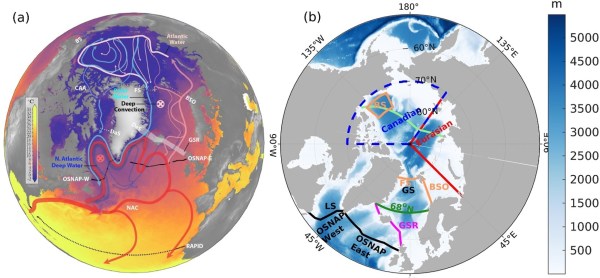
A new observation-based reconstruction of the AMOC identifies a sustained weakening across the entire Atlantic basin since 1960

This blog post and the “Deep Dive” podcast, created by NotebookLM, are based on “Multi-decadal weakening of the Atlantic Overturning from a physics and observation-based reconstruction” by Li et al. (2026). A preprint article by Li et al. (2026) details a new scientific reconstruction of the Atlantic meridional overturning circulation (AMOC) since 1940, utilizing a... Continue Reading →

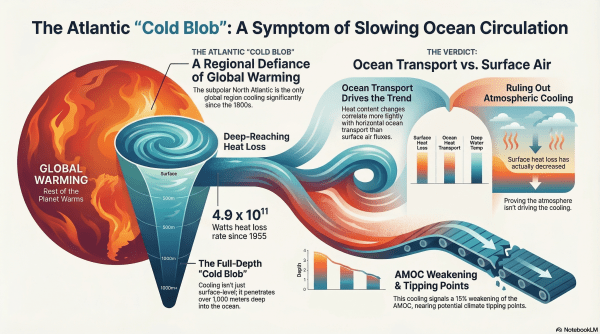
Why Is the North Atlantic Getting Cold?

This blog post and the “Deep Dive” podcast, created by NotebookLM, are based on “Post-1950s Atlantic 'warming hole' is caused by ocean heat transport change, not surface fluxes” by Rahmstorf et al. (2026). This preprint paper investigates the "cold blob," a unique region in the North Atlantic that has cooled since the 19th century despite... Continue Reading →

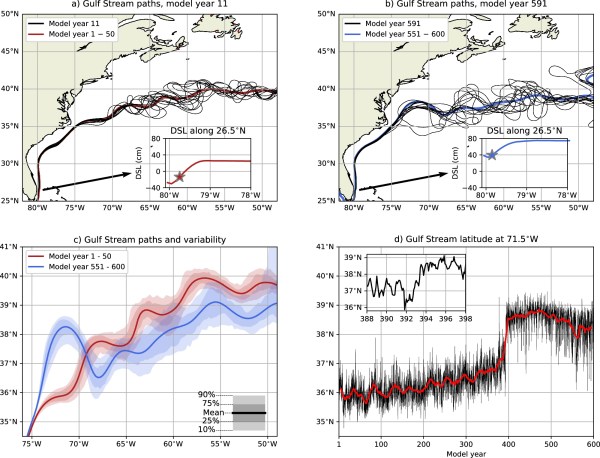
Shifting Gulf Stream is the First Alarm for a Collapsing Atlantic Circulation

This blog post and the “Deep Dive” podcast, created by NotebookLM, are based on “Abrupt Gulf Stream path changes are a precursor to a collapse of the Atlantic Meridional Overturning Circulation” by van Westen & Dijkstra (2026). This research explores how abrupt changes in the Gulf Stream's path act as an early warning sign for a potential collapse... Continue Reading →

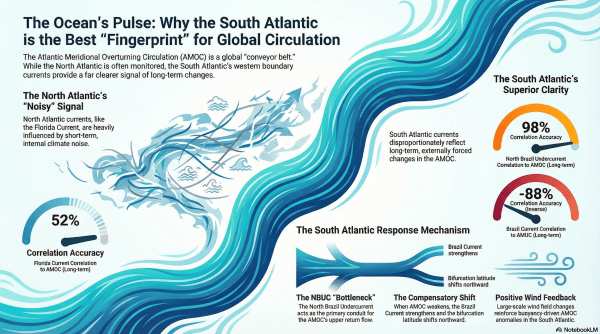
Why the South Atlantic is Key to Monitoring the Future Weakening of the AMOC

This blog post and the “Deep Dive” podcast, created by NotebookLM, are based on “Rainfall sustains multiyear La Niña” by Tian et al. (2026). This research investigates how the Atlantic Meridional Overturning Circulation (AMOC) imprints its signal on regional ocean currents, specifically comparing the North and South Atlantic. By analyzing 22,000 years of climate simulations,... Continue Reading →

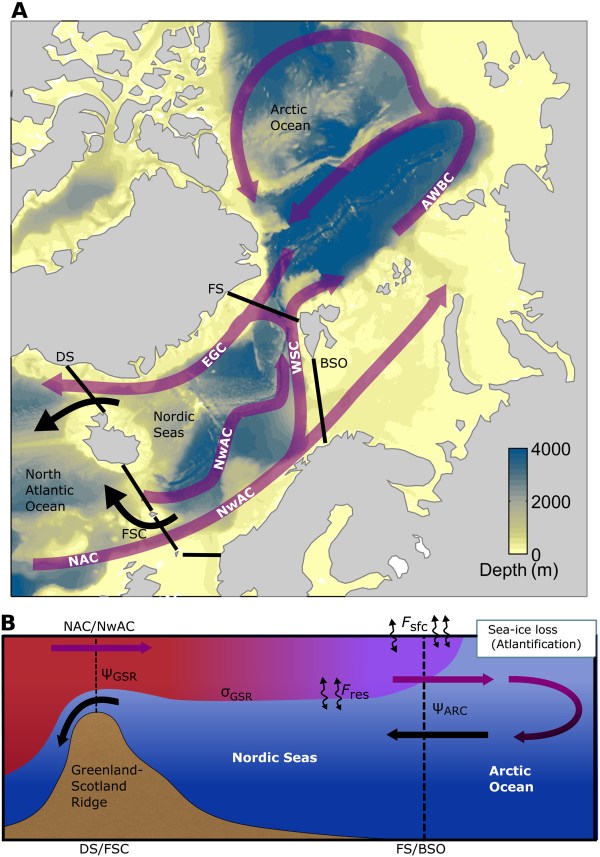
The Arctic’s New Engine: Why the Great Ocean Conveyor Belt is Defying the Warming Trend

This blog post and the “Deep Dive” podcast, created by NotebookLM, are based on “Atlantification drives recent strengthening of the Arctic overturning circulation” by Årthun et al. (2026). A recent study examines how Atlantification, the northward expansion of warm Atlantic waters, is altering the Arctic overturning circulation. While traditional source regions for dense water in the Nordic Seas have... Continue Reading →

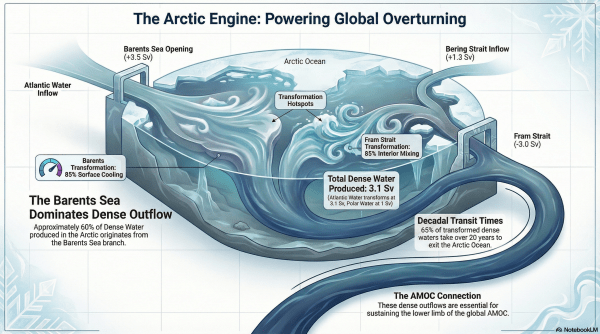
The Barents Sea – Arctic Engine Powering the Global Meridional Overturning Circulation

This blog post and the “Deep Dive” podcast, created by NotebookLM, are based on "The Arctic overturning circulation: transformations, pathways and timescales” by Dörr et al. (2026). Dörr et al. (2026) investigates the Arctic overturning circulation by analyzing how warm Atlantic Water is converted into Dense and Polar Waters. Utilizing a high-resolution ocean model and Lagrangian tracking, the authors... Continue Reading →

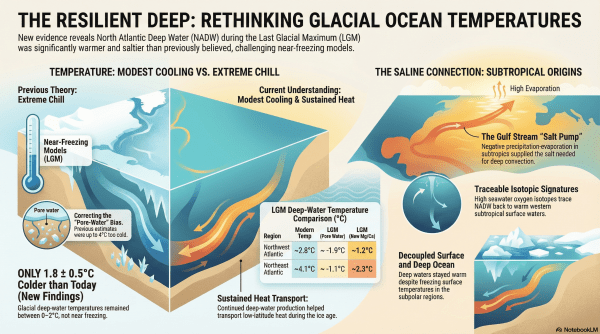
Salt Maintained Persistent Deep-Water Formation in the Glacial North Atlantic

This blog post and the “Deep Dive” podcast, created by NotebookLM, are based on a preprint article “Relatively warm deep-water formation persisted in the Last Glacial Maximum” by Wharton et al. (2026). This research investigates the state of the deep North Atlantic Ocean during the Last Glacial Maximum, challenging previous theories that the deep sea... Continue Reading →

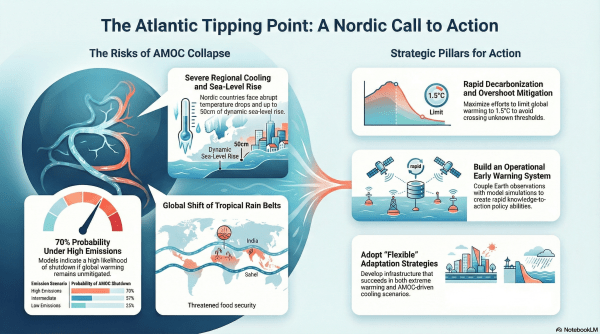
Scientists Urge International Cooperation to Mitigate a Catastrophic AMOC Failure

This blog post and the “Deep Dive” podcast, created by NotebookLM, are based on “A Nordic Perspective on AMOC Tipping: Impacts and Strategies for Prevention and Governance” by Nummelin et al. (2026). For centuries, the North Atlantic has functioned as the Earth’s thermal engine, driven by a "heartbeat" known as the Atlantic Meridional Overturning Circulation... Continue Reading →

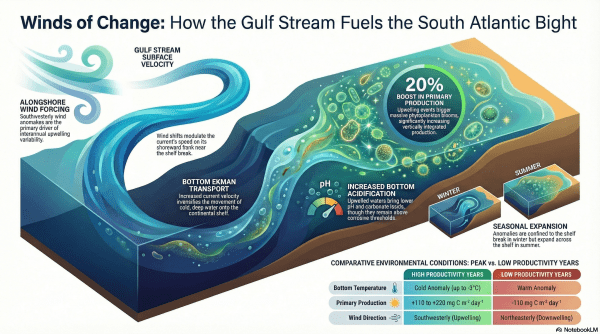
Local Winds Shape the South Atlantic Bight Primary Productivity and Acidity

This blog post and the “Deep Dive” podcast, created by NotebookLM, are based on “Wind control of the interannual ocean-biogeochemical variability in the South Atlantic Bight.” by Gomez et al. (2026). This research investigates how alongshore wind variability and the Gulf Stream control interannual changes in the marine ecosystem of the South Atlantic Bight. By... Continue Reading →

Steering the Deep Atlantic Conveyor Belt: The Role of the Eastern Arctic’s Eurasian Basin

This blog post and the “Deep Dive” podcast, created by NotebookLM, are based on “Impacts of eastern Arctic Eurasian Basin water mass properties on the AMOC and Beaufort Sea Atlantic water layer.” by Wei and Zhang (2026). Wei and Zhang (2026) investigates how water mass properties in the eastern Eurasian Basin influence global ocean patterns... Continue Reading →

Website Powered by WordPress.com.

Up ↑