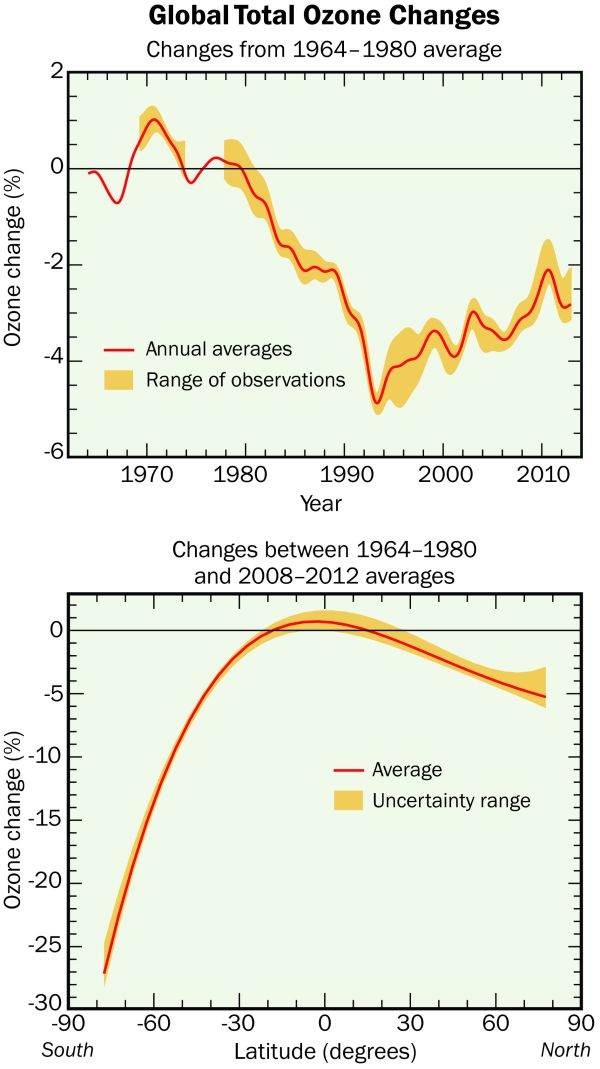
This new paper published in Science suggests that as the tropical oceans get warmer, ocean emissions of methyl bromide (CH3Br) and other short-lived ozone-depleting substances will increase, slowing down the ongoing ozone recovery. Image credit: Scientific assessment of ozone depletion 2014 http://science.sciencemag.org/content/358/6368/1257 https://www.esrl.noaa.gov/research/themes/o3/ http://science.sciencemag.org/content/353/6296/269
Arctic report card: update for 2017
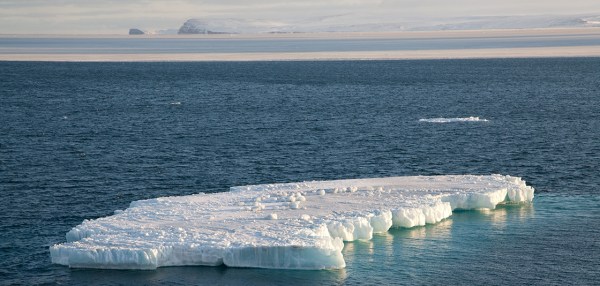
NOAA's Arctic program released Arctic Report Card Update for 2017. The report finds "Arctic shows no sign of returning to reliably frozen region of recent past decades", "The sea ice cover continues to be relatively young and thin with older, thicker ice comprising only 21% of the ice cover in 2017 compared to 45% in 1985.", and... Continue Reading →
Explaining extreme events from a climate perspective
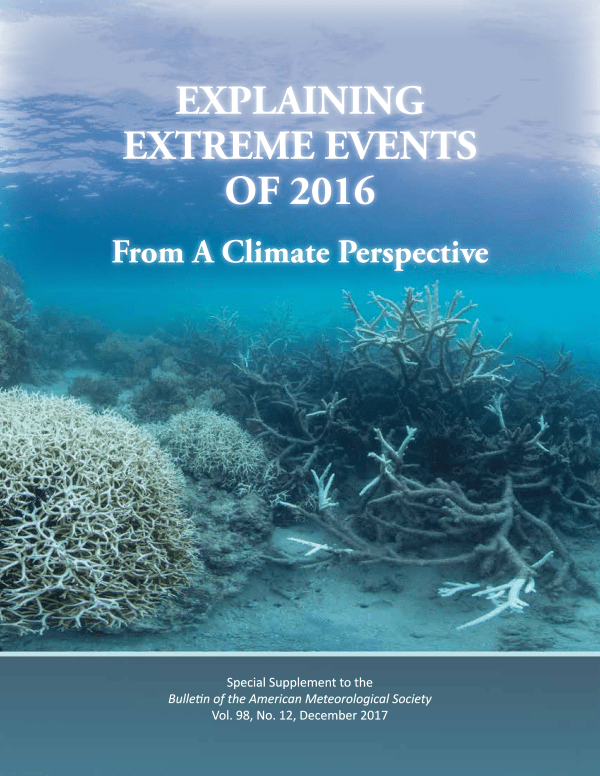
This special report of the Bulletin of the American Meteorological Society (BAMS) presents some extreme events in 2016, such as the record global heat, the heat across Asia, the 2015-16 El Niño and a marine heat wave off the coast of Alaska, and discusses how human-caused climate change may have affected the strength and likelihood of these extreme events.... Continue Reading →
On the fragile relationship between El Niño and California rainfall
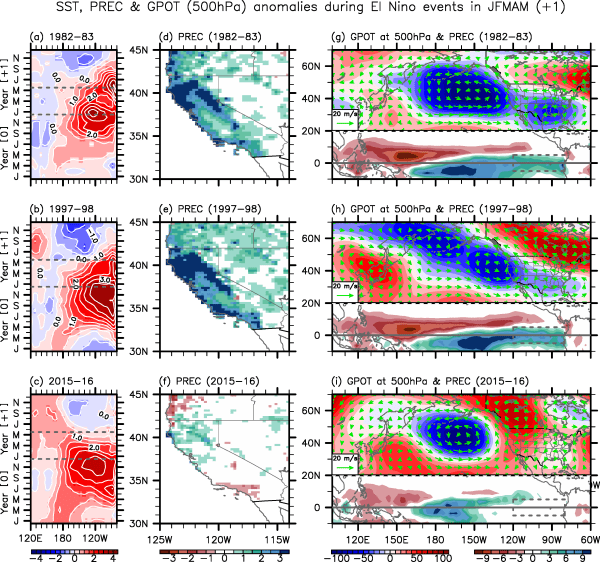
This study newly accepted in Geophysical Research Letters examined why California experienced extremely wet winter and spring conditions during the 1997-98 and 1982-83 El Niños, but near normal rainfall during the extremely strong 2015-16 El Niño. Statistical data analyses and simple model experiments were used to show that sufficiently warm and persistent sea surface temperature anomalies... Continue Reading →
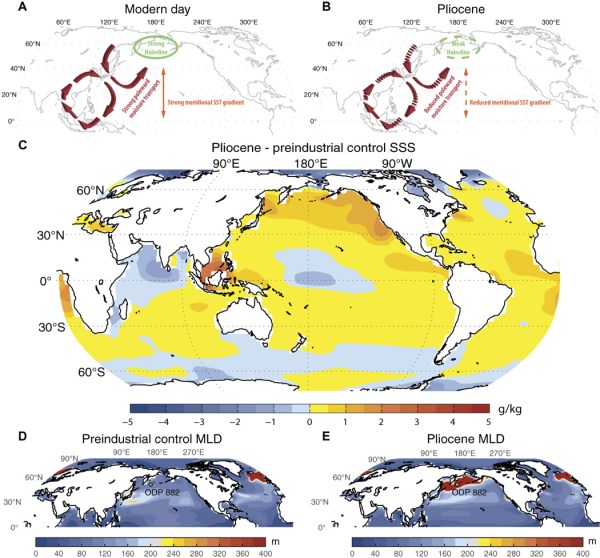
Active Pacific meridional overturning circulation (PMOC) during the warm Pliocene
An essential element of modern ocean circulation and climate is the Atlantic meridional overturning circulation (AMOC), which includes deep-water formation in the subarctic North Atlantic. However, a comparable overturning circulation is absent in the Pacific, the world’s largest ocean, where relatively fresh surface waters inhibit North Pacific deep convection. We present complementary measurement and modeling... Continue Reading →
Interannual variability of western North Pacific SST anomalies and its impact on North Pacific and North America
In this study, the interannual variability of sea surface temperature (SST) and its atmospheric teleconnection over the western North Pacific (WNP) toward the North Pacific/North America during boreal winter are investigated. First, we defined the WNP mode as the first empirical orthogonal function (EOF) mode of SST anomalies over the WNP region (100–165°E, 0–35°N), of... Continue Reading →
Global atmospheric teleconnections and multidecadal climate oscillations driven by Southern Ocean convection
A 1000-yr control simulation in a low-resolution coupled atmosphere–ocean model from the Geophysical Fluid Dynamics Laboratory (GFDL) family of climate models shows a natural, highly regular multidecadal oscillation between periods of Southern Ocean (SO) open-ocean convection and nonconvective periods. It is shown here that convective periods are associated with warming of the SO sea surface... Continue Reading →
Multidecadal weakening of Indian summer monsoon circulation induces an increasing northern Indian Ocean sea level
North Indian Ocean sea level has shown significant increase during last three to four decades. Analyses of long-term climate data sets and ocean model sensitivity experiments identify a mechanism for multidecadal sea level variability relative to global mean. Our results indicate that North Indian Ocean sea level rise is accompanied by a weakening summer monsoon... Continue Reading →
El Niño-like teleconnection increases California precipitation in response to warming
Future California (CA) precipitation projections, including those from the most recent Climate Model Intercomparison Project (CMIP5), remain uncertain. This uncertainty is related to several factors, including relatively large internal climate variability, model shortcomings, and because CA lies within a transition zone, where mid-latitude regions are expected to become wetter and subtropical regions drier. Here, we... Continue Reading →
Future loss of Arctic sea-ice cover could drive a substantial decrease in California’s rainfall
From 2012 to 2016, California experienced one of the worst droughts since the start of observational records. As in previous dry periods, precipitation-inducing winter storms were steered away from California by a persistent atmospheric ridging system in the North Pacific. Here we identify a new link between Arctic sea-ice loss and the North Pacific geopotential... Continue Reading →