North Atlantic zonal winds will shift northward and become more extreme in the future
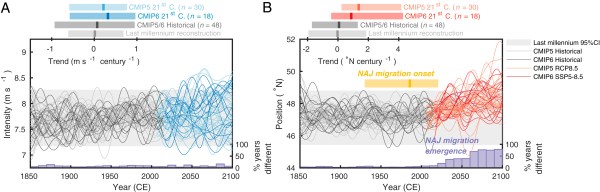
The warming response of the upper atmosphere is much stronger in the tropics due to higher water vapor content and frequent deep tropical convection that maintains the atmosphere column well-mixed. As a result, the zonal jet strength, which is largely proportional to the meridional gradient of atmosphere temperature via "thermal wind relationship" is projected to... Continue Reading →

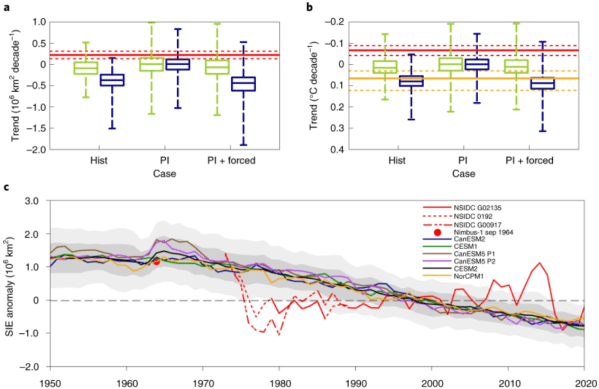
Why climate models are unable to reproduce the observed Antarctic sea-ice expansion

Antarctic sea-ice has expanded over the period of continuous satellite monitoring, which seemingly contradicts ongoing global warming resulting from increasing concentrations of greenhouse gases. A variety of hypotheses have been proposed to explain the observed Antarctic sea-ice expansion and corresponding model–observation discrepancy, but the issue remains unresolved. In a new study published in Nature Climate... Continue Reading →

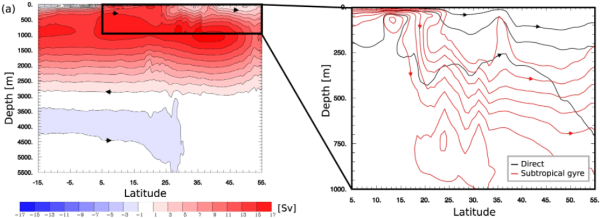
An overlooked role of the subtropical gyre circulation in regulating the AMOC

It is a common practice in Physical Oceanography to separate the Atlantic Ocean circulations into the meridional overturning and wind-driven gyre components with an assumption that the two components are largely independent of each other. An article published in Nature Communications suggests that the two components are not at all independent. The study shows that... Continue Reading →

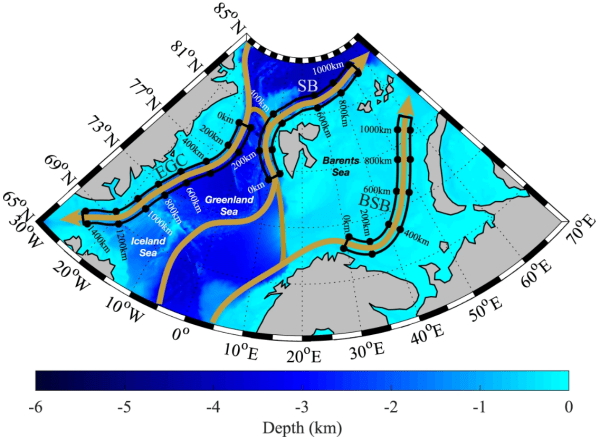
Sea-ice retreat may invigorate the weakening Atlantic Meridional Overturning Circulation

Due to rapidly rising air temperature over the Arctic and subarctic regions, the ocean-to-air turbulent (i.e., sensible and latent) heat flux over the Greenland, Iceland, and Norwegian Seas (GINS) has diminished (i.e., less cooling of the surface ocean) steadily during the satellite period (i.e., since the 1970s). This may lead to a reduction of deep... Continue Reading →

Future El Niño events will develop faster and persist longer

Previous studies based on the climate models participating in the Coupled Model Intercomparison Project (CMIP) have suggested an increase in the frequency of extreme El Niño events in the 21st Century in response to increasing greenhouse gases. Several studies have attributed these shifts in El Niño frequency and amplitude to the projected changes in the... Continue Reading →

Tips for making a science paper easy to follow

The editorial team of Nature's Communication Earth & Environment recommends a few achievable ways of making a science paper easier to follow: Scientific writing closely follows a formula that has proven successful. Simply answer a few questions in your paper, one after the other: why is your topic of interest? What has been done before?... Continue Reading →

ENSO plays little role in early-season Atlantic hurricane activity

This is a guest blog by Robert West. Robert is a postdoctoral research associate in the Northern Gulf Institute (NGI) at the Mississippi State University and is also affiliated with NOAA's Atlantic Oceanographic and Meteorological Laboratory. Differences in sea surface temperature anomalies (SSTAs) between the tropical Atlantic and Pacific oceans are known to influence atmospheric... Continue Reading →

Gift authorship, guest authorship, and surprise authorship – common abuses of authorship

If you are a scientist or technician working at a federal research laboratory or a research university, probably you have experienced or at least heard about abuses of authorship. An article written by Joseph Flotemersch and Justicia Rhodus summarizes several common cases of abuse of authorship reported in the literature. For instance, it is surprisingly... Continue Reading →

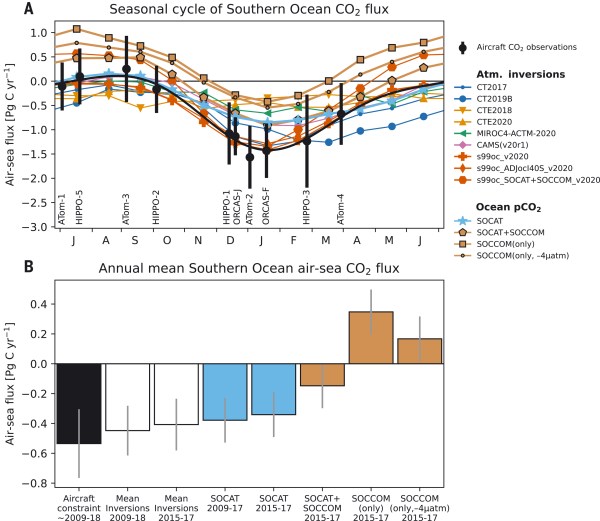
New aircraft-based observations confirm the role of the Southern Ocean as a significant carbon sink

Ship-based CO2 flux estimates of the contemporary air-sea flux of CO2 showed that the Southern Ocean (south of 35oS) plays an important role as a significant carbon sink, with a net uptake at the rate of −0.8 ~ −1.0 Pg C/year (Takahashi et al., 2009; Landschützer et al., 2014) largely consistent with climate model-based estimates... Continue Reading →

Increasing river alkalinity slows ocean acidification in river-dominated ocean margins

Although ocean acidification (OA) is mainly driven by the ocean uptake of anthropogenic carbon dioxide from the atmosphere, multiple factors including changes in ocean temperature, biological processes, and river discharge influence its temporal progression. In a new paper accepted in the Geophysical Research Letters, a team of researchers from the Northern Gulf Institute of the... Continue Reading →

Website Powered by WordPress.com.

Up ↑