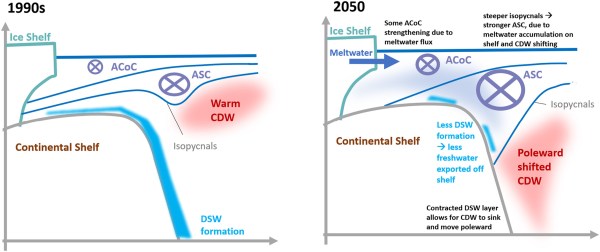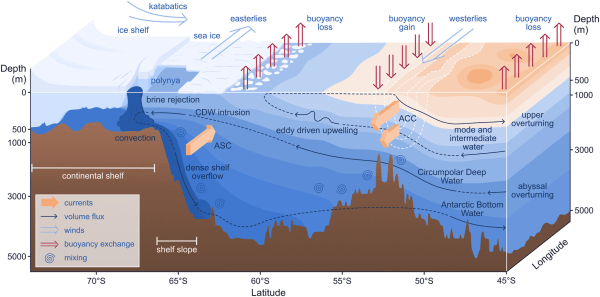
The Antarctic Slope Current (ASC) is the westward-flowing coastal current system around Antarctica, largely driven by easterly winds. It serves as a barrier to heat and salt exchanges between the cold, fresh Antarctic ice shelf region and the warm, salty Circumpolar Deep Water (CDW) in the Southern Ocean. A weakening of the ASC allows more... Continue Reading →
A note on the potential AMOC collapse for nonexperts
As the Earth warms due to anthropogenic climate change, sea- and land-based ice melts, adding buoyant freshwater to the surface of the high-latitude North Atlantic and thus decreasing salinity. This makes the surface water lighter reducing the sinking of the surface water and thus the AMOC. However, the amount of added freshwater is not enough... Continue Reading →
Papers that I enjoyed reading in January 2025
Adams, K. H., Reager, J. T., Buzzanga, B. A., David, C. H., Sawyer, A. H., & Hamlington, B. D. (2024). Climate-induced saltwater intrusion in 2100: Recharge-driven severity, sea level-driven prevalence. Geophysical Research Letters, 51, e2024GL110359. https://doi.org/10.1029/2024GL110359: The projected increase in regional saltwater intrusion to Aquafer (for drinking & etc) is driven not only (1) by... Continue Reading →
The annual mean AMOC in 2022 is the lowest after its biggest drop in 2009
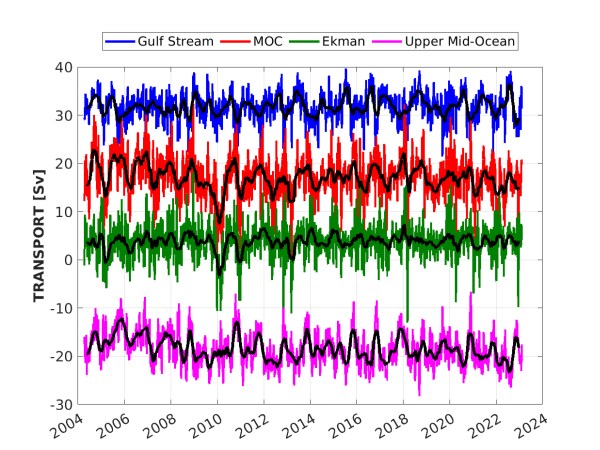
Scientists have been monitoring the Atlantic Meridional Overturning Circulation (AMOC) at around 26.5°N since April 2004 through the RAPID/Meridional Overturning Circulation and Heatflux Array/Western Boundary Time Series moored array (RAPID). The newly released RAPID dataset fully incorporated a recent geomagnetic correction of the submarine cable measurement of the Florida Current transport, a critical component of... Continue Reading →
Increasing frequency of “moist” heatwaves
Heatwaves usually come with dry conditions because the regions under the so-called heat dome, which is typically responsible for severe heatwave events, are deprived of moisture and rainfall. However, in the southern US states under semi-tropical environments, "moist" heatwave events may occur, causing both the temperature and humidity stresses on human physiology. But, you may... Continue Reading →
AMOC collapse is unlikely in the near future
A new study published in Science (Zhou and McManus, 2024) reconstructed the land ice melting (or discharge) rate during the intermittent events of ice melting in the last glacial period (i.e., Heinrich events). The study showed that the present-day Greenland Ice Sheet melting rate (since the 1980s) is comparable to that during weak-to-moderate strength Heinrich events. This... Continue Reading →