The Atlantic’s Weakening Pulse: How a Slowing Ocean Current Could Reshape Our Climate and Coasts

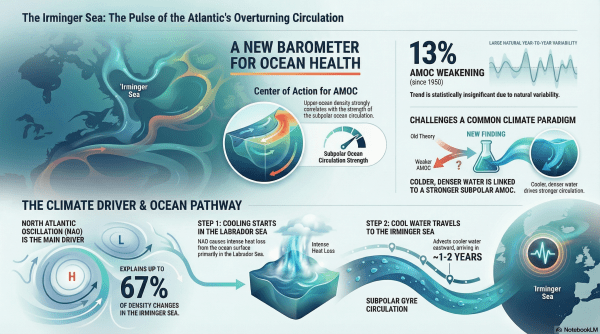
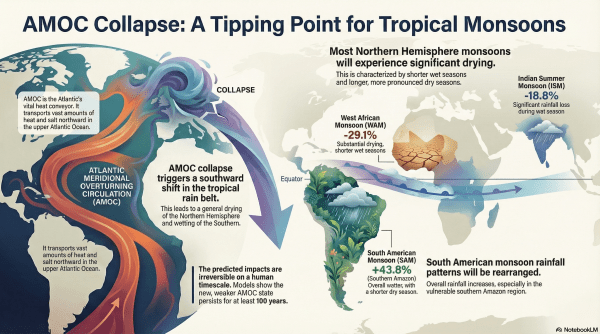
This blog post and the “Deep Dive” podcast, created by NotebookLM, are based on "State of the Science Fact Sheet: Atlantic Meridional Overturning Circulation (AMOC)" by NOAA Science Council. This NOAA fact sheet briefly explains the Atlantic Meridional Overturning Circulation (AMOC), defining it as a critical ocean current that transports heat, salt, and carbon by... Continue Reading →

The Atlantic’s Slowing “Heartbeat”: How a Fading Ocean Current Is Silencing a Major Climate Pattern

This blog post and the “Debate” podcast on a paper “Atlantic Meridional Overturning Circulation slowdown suppresses Atlantic Niño variability” by Freire-SouzaLi et al. (2025) was created by NotebookLM. Debate Podcast: This is different from Deep Dive Podcast. This is a debate between two hosts, illuminating different perspectives on the study, “Meltwater or Warming Drives Atlantic... Continue Reading →

A two-level wind and buoyancy driven thermocline model by Peter Killworth (updated)

I was discussing with my colleagues about a recent northward shift of the Gulf Stream position and debating why that happened. So, I decided to read again one of my favorite physical oceanography papers "A two-level wind and buoyancy driven thermocline model" by the late Dr. Peter D. Killworth. This paper was published in 1985... Continue Reading →

A note on the potential AMOC collapse for nonexperts

As the Earth warms due to anthropogenic climate change, sea- and land-based ice melts, adding buoyant freshwater to the surface of the high-latitude North Atlantic and thus decreasing salinity. This makes the surface water lighter reducing the sinking of the surface water and thus the AMOC. However, the amount of added freshwater is not enough... Continue Reading →

Papers that I enjoyed reading in January 2025

Adams, K. H., Reager, J. T., Buzzanga, B. A., David, C. H., Sawyer, A. H., & Hamlington, B. D. (2024). Climate-induced saltwater intrusion in 2100: Recharge-driven severity, sea level-driven prevalence. Geophysical Research Letters, 51, e2024GL110359. https://doi.org/10.1029/2024GL110359: The projected increase in regional saltwater intrusion to Aquafer (for drinking & etc) is driven not only (1) by... Continue Reading →

Human-induced weakening of the AMOC averted for now

The current state-of-the-art climate models suggest that the human-induced weakening of the Atlantic Meridional Overturning Circulation (AMOC) has already begun since the mid-1980s. However, continuous direct observational records during the past two decades have shown no clear sign of a slowing down of the AMOC. To shed light on this apparent contradiction, a new study... Continue Reading →

The annual mean AMOC in 2022 is the lowest after its biggest drop in 2009

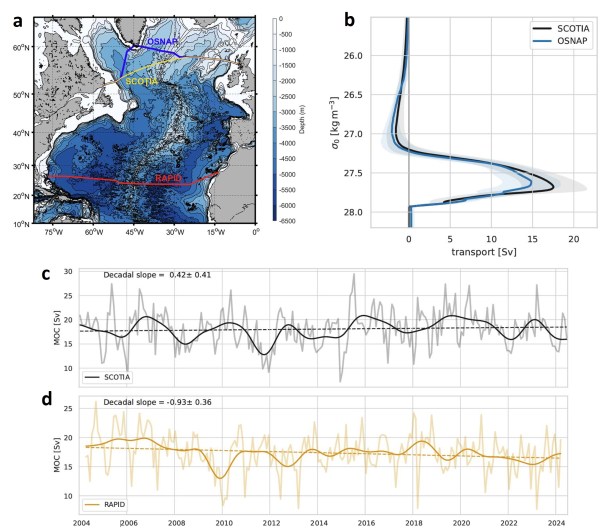
Scientists have been monitoring the Atlantic Meridional Overturning Circulation (AMOC) at around 26.5°N since April 2004 through the RAPID/Meridional Overturning Circulation and Heatflux Array/Western Boundary Time Series moored array (RAPID). The newly released RAPID dataset fully incorporated a recent geomagnetic correction of the submarine cable measurement of the Florida Current transport, a critical component of... Continue Reading →

AMOC collapse is unlikely in the near future

A new study published in Science (Zhou and McManus, 2024) reconstructed the land ice melting (or discharge) rate during the intermittent events of ice melting in the last glacial period (i.e., Heinrich events). The study showed that the present-day Greenland Ice Sheet melting rate (since the 1980s) is comparable to that during weak-to-moderate strength Heinrich events. This... Continue Reading →

Website Powered by WordPress.com.

Up ↑