During the satellite era (1979-present), the tropical Pacific Ocean has warmed significantly less than the other tropical oceans in response to increasing greenhouse gases (GHGs). This La Niña-like warming trend in observations is in disagreement with the El Niño-like warming trend projected by the Coupled Model Intercomparison Project (CMIP) models for both the 20th and... Continue Reading →
ENSO forecasts extended to 18 months?
According to the recharge-discharge oscillator theory (Jin, 1997), the leading mode of tropical Pacific upper ocean heat content anomalies is a predictor (or a precursor) for the onset of El Niño - Southern Oscillation (ENSO) at the interannual time scale. A new study published in Nature (Zhao et al., 2024) utilized multiple global sea surface... Continue Reading →
Atlantic Niña brewing: An implication for the 2024 hurricane season
Currently (as of June 22, 2024), a phenomenon known as Atlantic Niña is brewing in the tropical Atlantic Ocean. As the Atlantic counterpart of La Niña in the Pacific, Atlantic Niña is characterized by the appearance of cold sea surface temperature anomalies (SSTAs) in the eastern equatorial Atlantic. It is known to reduce rainfall and... Continue Reading →
Quad-State Tornado Outbreaks promoted by a long-lived PNA
On December 10, 2021, one of the most destructive winter tornado outbreaks developed in northeastern Arkansas. This tornado outbreak, later coined as the Quad-State Tornado Outbreaks by the news media, struck portions of the Ohio Valley, including Missouri, Illinois, Tennessee, and Kentucky, from December 10 to 11, 2021. According to the National Oceanic and Atmospheric... Continue Reading →
AMOC collapse is unlikely in the near future
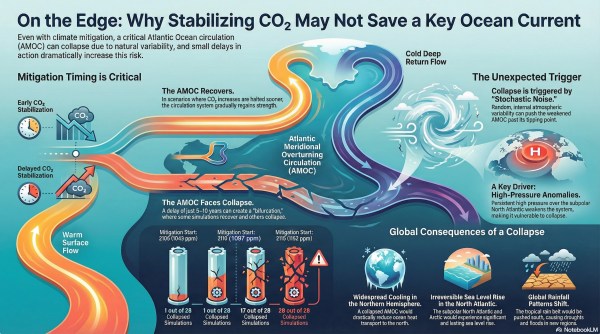
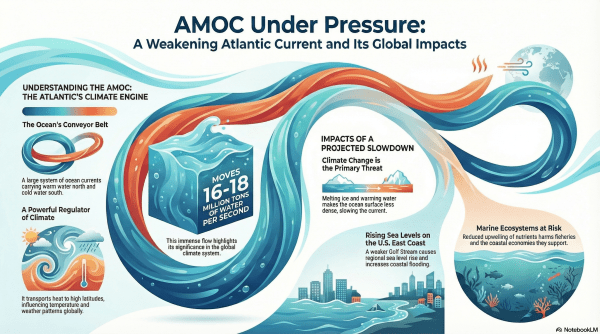
A new study published in Science (Zhou and McManus, 2024) reconstructed the land ice melting (or discharge) rate during the intermittent events of ice melting in the last glacial period (i.e., Heinrich events). The study showed that the present-day Greenland Ice Sheet melting rate (since the 1980s) is comparable to that during weak-to-moderate strength Heinrich events. This... Continue Reading →
Letter to a Young Ecologist
This short essay by Daniel C. Laughlin is beneficial not only for young ecologists but also for all scientists both young and old. The author spoke of three elements of ecology: natural history, quantitative reasoning, and communication. If you are an oceanographer or climate scientist, you may want to substitute "natural history" with "observational data" for... Continue Reading →
Sustained ocean measurements at 34°S crucial for estimating the distance to an AMOC collapse
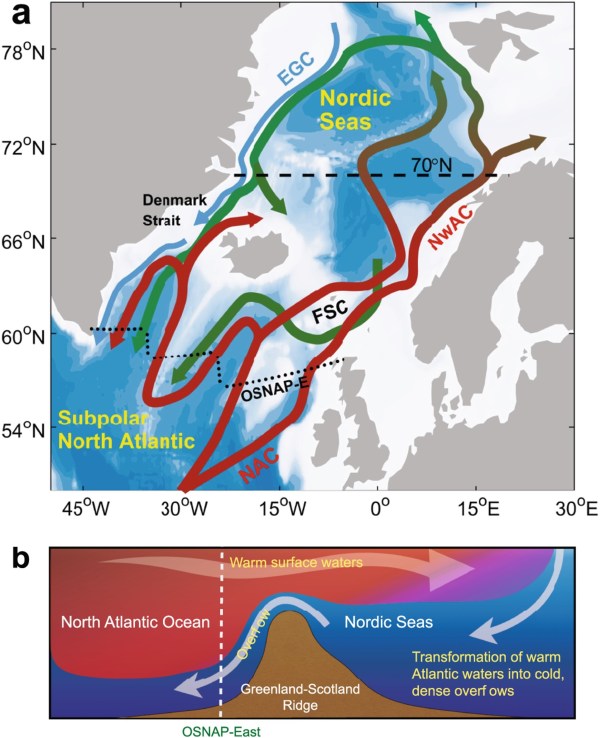
The Atlantic Meridional Overturning Circulation (AMOC) transports warm and salty upper ocean water to the subpolar North Atlantic where the upper ocean releases some heat to the atmosphere. Due to the surface cooling and the high salinity (i.e., salty), the upper ocean water becomes heavier and thus sinks down to the deep ocean and then... Continue Reading →
Climate and weather scientists in the U.S. don’t talk to each other
As a climate scientist, I have worked and interacted with many weather scientists in the past 20 years or so. I am also currently in a task force team to advance subseasonal (2~4 weeks) forecasts of severe weather activity in the U.S. I have learned so much from weather scientists about how longer-term climate processes... Continue Reading →
Why is it hard to identify the subpolar and subtropical jets from zonal-mean zonal wind profiles?
Two important atmospheric jet streams that shape the extratropical zonal wind field in both hemispheres are the subtropical jet and the subpolar jet. The subtropical jet is located around 30° latitude line at the boundary between the Hadley cell and the Ferrel cell, and is predominantly a high-altitude feature. Since it is largely in thermal-wind... Continue Reading →
Useful editing tips from climate science editor
Michael White is a climate science editor for Nature. He posted on Twitter a list of useful tips for climate scientists to consider before they submit their work to Nature or other journals. Personally, I would like to stress his suggestion to avoid subjective wording like “unprecedented”, “dramatic”, and “remarkable”. Such a subjective word gives... Continue Reading →