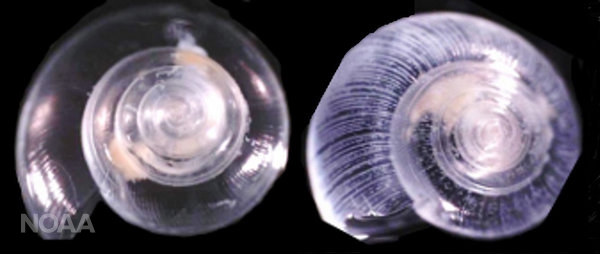
Oceans worldwide are undergoing acidification due to the penetration of anthropogenic CO2 from the atmosphere. The rate of acidification generally diminishes with increasing depth. Yet, slowing down of the thermohaline circulation due to global warming could reduce the pH in the deep oceans, as more organic material would decompose with a longer residence time. To... Continue Reading →
A pan-tropical cascade of fire driven by El Niño – Southern Oscillation
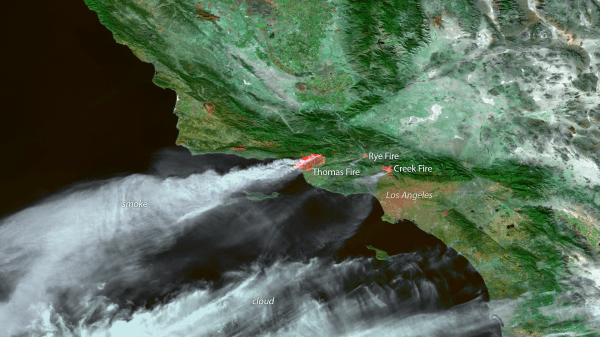
The El Niño/Southern Oscillation (ENSO) has a pronounced influence on year-to-year variations in climate. The response of fires to this forcing is complex and has not been evaluated systematically across different continents. Here we use satellite data to create a climatology of burned-area and fire-emissions responses, drawing on six El Niño and six La Niña... Continue Reading →
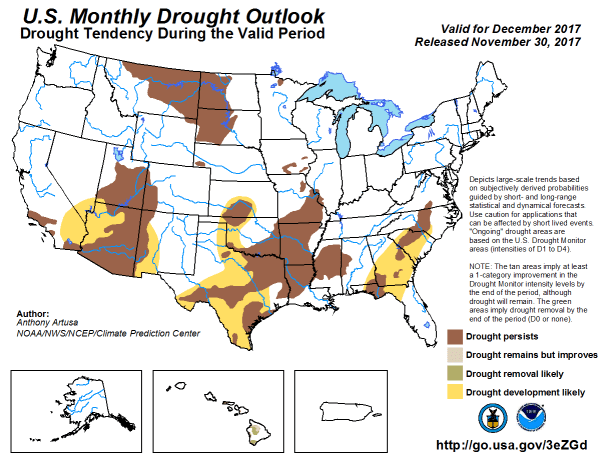
Drought conditions will maintain across a significant portion of the contiguous United States during December 2017
According to the US monthly drought outlook issued by NOAA CPC in November 30, the current severe drought conditions will maintain over the southern US. This is likely due to the developing La Nina condition in the Pacific. During La Niña, the winter atmospheric jet stream in the Pacific often takes an unusually wavy path... Continue Reading →
Meridional Overturning Circulation (MOC) in Europa?
This article appeared in Nature Geoscience in 2014 used a numerical model to hypothesize that a meridional overturning circulation (MOC) exists in the ocean beneath the icy surface of Jupiter's moon Europa. The geothermal heat generated from tidal flexing drives Europa's MOC, which carries heat toward the surface in the low latitudes then poleward. This study... Continue Reading →
Highlights of the findings of the U.S. global change research program climate science special report
This executive summary presents the Fourth National Climate Assessment (NCA4), an authoritative assessment of the science of climate change, with a focus on the United States. This represents the first of two volumes of the Fourth National Climate Assessment, mandated by the Global Change Research Act of 1990. https://science2017.globalchange.gov/chapter/executive-summary/
Tropical explosive volcanic eruptions can trigger El Niño by cooling tropical Africa
Stratospheric aerosols from large tropical explosive volcanic eruptions backscatter shortwave radiation and reduce the global mean surface temperature. Observations suggest that they also favour an El Niño within 2 years following the eruption. Modelling studies have, however, so far reached no consensus on either the sign or physical mechanism of El Niño response to volcanism.... Continue Reading →
The central role of ocean dynamics in connecting the North Atlantic Oscillation to the extratropical component of the Atlantic Multidecadal Oscillation
The relationship between the North Atlantic Oscillation (NAO) and Atlantic sea surface temperature (SST) variability is investigated using models and observations. Coupled climate models are used in which the ocean component is either a fully dynamic ocean or a slab ocean with no resolved ocean heat transport. On time scales less than 10 yr, NAO... Continue Reading →
Shift from coral to macroalgae dominance on a volcanically acidified reef
Rising anthropogenic CO2 in the atmosphere is accompanied by an increase in oceanic CO2 and a concomitant decline in seawater pH. This phenomenon, known as ocean acidification (OA), has been experimentally shown to impact the biology and ecology of numerous animals and plants, most notably those that precipitate calcium carbonate skeletons, such as reef-building corals.... Continue Reading →
Decade-long deep-ocean warming detected in the subtropical South Pacific
The persistent energy imbalance at the top of the atmosphere, inferred from satellite measurements, indicates that the Earth's climate system continues to accumulate excess heat. As only sparse and irregular measurements of ocean heat below 2000 m depth exist, one of the most challenging questions in global climate change studies is whether the excess heat has... Continue Reading →