Hurricane Harvey links to ocean heat content and climate change adaptation

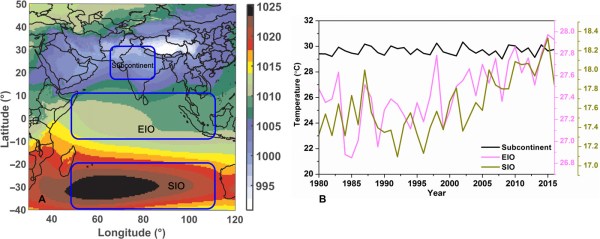
While hurricanes occur naturally, human‐caused climate change is supercharging them and exacerbating the risk of major damage. Here, using ocean and atmosphere observations, we demonstrate links between increased upper ocean heat content due to global warming with the extreme rainfalls from recent hurricanes. Hurricane Harvey provides an excellent case study as it was isolated in... Continue Reading →

Meridional overturning circulation conveys fast acidification to the deep Atlantic Ocean posing a severe threat to cold-water coral habitats.

Increasing atmospheric carbon dioxide concentrations are increasing the acidity of the oceans and reducing carbonate-ion concentrations, making it difficult for corals to maintain their calcium carbonate skeletons. This paper reports a roughly 40 per cent reduction in the transport of carbonate ions to the deep North Atlantic ocean since preindustrial times, with implications for cold-water... Continue Reading →

Ocean dynamics plays a key role in driving the Atlantic Multidecadal Oscillation (AMO)

The recently proposed atmosphere-forced thermodynamics mechanism of the AMO challenged the well-known ocean dynamics mechanism, and thus it is important to identify a key feature associated with the AMO that can be used to distinguish between the two mechanisms. In this study, the spatial structure of AMO is analyzed and compared between the observations and... Continue Reading →

Northward shift of the East Asian summer monsoon enhances US summer rainfall variability

The strength of the dominant variability of contiguous United States (CONUS) summer rainfall during 1960–2013 experiences an interdecadal change in the early 1990s. Before the early 1990s, the variation in CONUS summer rainfall is relatively small in amplitude (standard deviation: 0.64  mm per day), whereas after it amplifies remarkably, with its standard deviation (1.31  mm... Continue Reading →

The boundary that separates the humid East US from the semi-arid West is shifting eastward

The 100th meridian bisects the Great Plains of the United States and effectively divides the continent into more arid western and less arid eastern halves and is well expressed in terms of vegetation, land hydrology, crops, and the farm economy. Here, it is considered how this arid–humid divide will change in intensity and location during... Continue Reading →

Net retreat of Antarctic glacier grounding lines

Grounding lines are a key indicator of ice-sheet instability, because changes in their position reflect imbalance with the surrounding ocean and affect the flow of inland ice. Although the grounding lines of several Antarctic glaciers have retreated rapidly due to ocean-driven melting, records are too scarce to assess the scale of the imbalance. Here, we... Continue Reading →

Is AMOC slowing down?

A recent article appeared in Nature  suggested that the AMOC has been very weak during the past 150 years since the end of the Little Ice Age (LIA) , and that enhanced freshwater fluxes from the Arctic and Nordic seas towards the end of the LIA weakened Labrador Sea convection and thus the AMOC. They... Continue Reading →

Influence of global warming on U.S. heat waves may be felt first in the West and Great Lakes regions

Climate projections for the twenty-first century suggest an increase in the occurrence of heat waves. However, the time at which externally forced signals of anthropogenic climate change (ACC) emerge against background natural variability (time of emergence (ToE)) has been challenging to quantify, which makes future heat-wave projections uncertain. Here we combine observations and model simulations... Continue Reading →

Ocean acidification affects coral growth by reducing skeletal density

Ocean acidification (OA) threatens coral reef futures by reducing the concentration of carbonate ions that corals need to construct their skeletons. However, quantitative predictions of reef futures under OA are confounded by mixed responses of corals to OA in experiments and field observations. We modeled the skeletal growth of a dominant reef-building coral, Porites, as a... Continue Reading →

Significant changes in the nutrient, carbon, and trace metal balances of the Arctic Ocean are underway

Rising temperatures in the Arctic Ocean region are responsible for changes such as reduced ice cover, permafrost thawing, and increased river discharge, which, together, alter nutrient and carbon cycles over the vast Arctic continental shelf. We show that the concentration of radium-228, sourced to seawater through sediment-water exchange processes, has increased substantially in surface waters... Continue Reading →

Website Powered by WordPress.com.

Up ↑