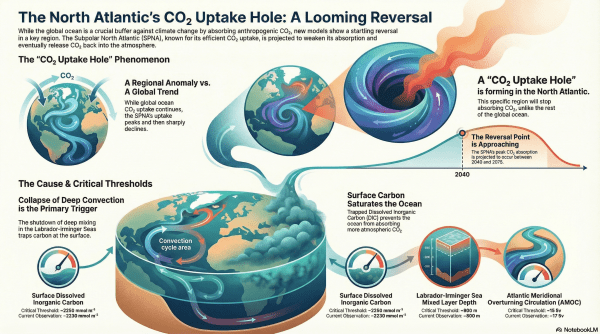
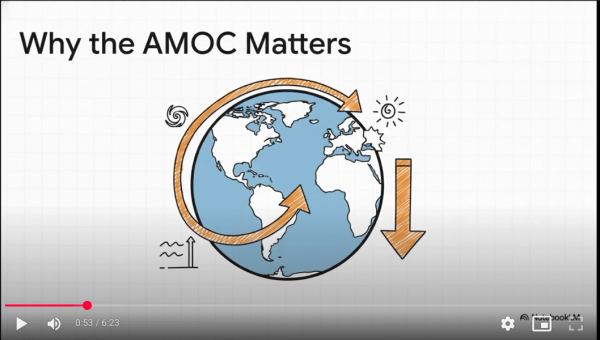
This blog post and the “Deep Dive” and "Critique " podcasts, created by NotebookLM, are based on “Emergence of an oceanic CO2 uptake hole under global warming” by Huiji Lee et al. (2025). Deep Dive Podcast “North Atlantic Carbon Sink Reverses Near-Term” powered by NotebookLM: Two hosts provide a critical analysis and constructive feedback to... Continue Reading →
You might be able to have your AI avatar to present your online seminar
This is not something that I look forward to. But, I can definitely understand the appeal. You don't need to rehearse your talk, dress up, drink a cup of tea to calm down your nerves. The technology is already here. New AI-powered platforms like DeeVid, Synthesia, and HeyGen can let you generate a talking avatar... Continue Reading →
Have you tried NotebookLM for a paper summary?
I usually spend about 10 ~ 20 minutes every morning for literature review before I start my daily routine. Sometimes, a paper looks very interesting, but requires me to spend more than 10 to 15 mins to be able to understand the main takeaway. This is particularly true for those papers with long abstracts and... Continue Reading →
Seasonal outlook of hurricane activity for five North Atlantic sub-basins
Seasonal hurricane outlooks, such as those issued by NOAA's Climate Prediction Center, Colorado State University (Klotzbach et al., 2017), European Center for Medium-Range Weather Forecasts, and University of Arizona (Davis and Zeng, 2019), produce skillful (i.e.,. better than climatology) seasonal forecasts of overall North Atlantic tropical cyclone (TC) activity. Such forecasts are possible because seasonal... Continue Reading →
A two-level wind and buoyancy driven thermocline model by Peter Killworth (updated)
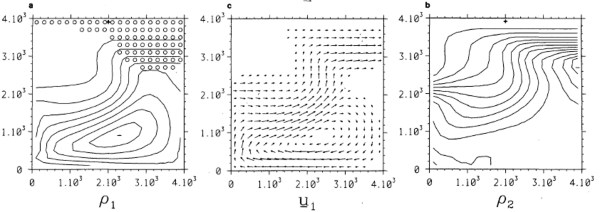
I was discussing with my colleagues about a recent northward shift of the Gulf Stream position and debating why that happened. So, I decided to read again one of my favorite physical oceanography papers "A two-level wind and buoyancy driven thermocline model" by the late Dr. Peter D. Killworth. This paper was published in 1985... Continue Reading →
Papers that I enjoyed reading in January 2025
Adams, K. H., Reager, J. T., Buzzanga, B. A., David, C. H., Sawyer, A. H., & Hamlington, B. D. (2024). Climate-induced saltwater intrusion in 2100: Recharge-driven severity, sea level-driven prevalence. Geophysical Research Letters, 51, e2024GL110359. https://doi.org/10.1029/2024GL110359: The projected increase in regional saltwater intrusion to Aquafer (for drinking & etc) is driven not only (1) by... Continue Reading →
Storm-resolving climate models project a 36% increase in the year-to-year variability of Atlantic hurricane activity by the 2050s
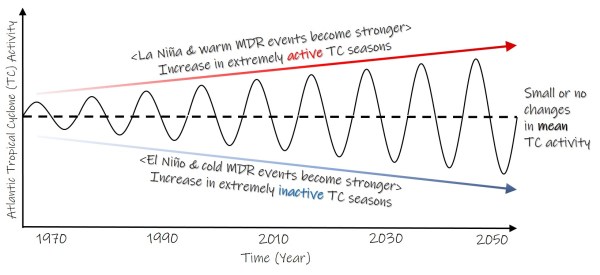
Tropical cyclone (TC) activity results in substantial loss of life and property damage. While the Atlantic basin has experienced a pronounced increase in accumulated cyclone energy (ACE) and the number of TCs over the past 50 years, TC-resolving climate models project a slight decrease in TC frequency throughout the 21st century (e.g., Roberts et al.,... Continue Reading →
Hurricane season got quiet (so far) & Sahel got wet
Recent news articles from the Washington Post "Why hurricane season is suddenly quiet — and what’s in store" and "A rare deluge could hit parts of the Sahara that almost never get rain this time of year" discussed two seemingly unconnected climate conditions around the tropical North Atlantic and West Africa. For the former, some... Continue Reading →
Atlantic Niña brewing: An implication for the 2024 hurricane season
Currently (as of June 22, 2024), a phenomenon known as Atlantic Niña is brewing in the tropical Atlantic Ocean. As the Atlantic counterpart of La Niña in the Pacific, Atlantic Niña is characterized by the appearance of cold sea surface temperature anomalies (SSTAs) in the eastern equatorial Atlantic. It is known to reduce rainfall and... Continue Reading →
Letter to a Young Ecologist
This short essay by Daniel C. Laughlin is beneficial not only for young ecologists but also for all scientists both young and old. The author spoke of three elements of ecology: natural history, quantitative reasoning, and communication. If you are an oceanographer or climate scientist, you may want to substitute "natural history" with "observational data" for... Continue Reading →