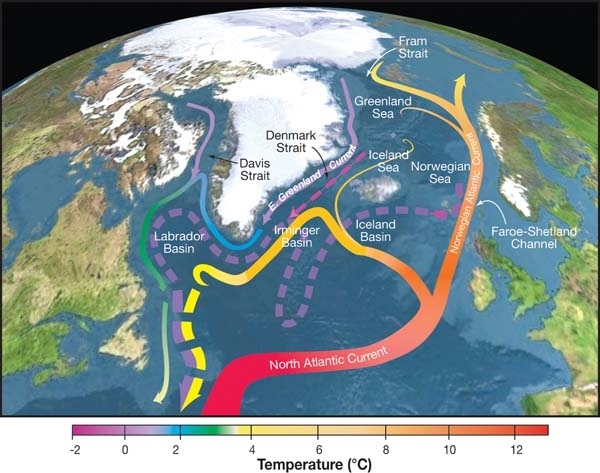
The Atlantic Meridional Overturning Circulation (AMOC) is the Atlantic component of the global ocean conveyor belt, which is a large-scale ocean circulation system that connects the Arctic, Atlantic, Indian, and Pacific Oceans via the Southern Ocean. Predominantly driven by deep convection in the high-latitude North Atlantic Ocean, the AMOC carries heat, salt, carbon, and other... Continue Reading →
Atlantic deep water is now warm enough to melt previously stable Greenland glacier
Ice sheet melting from Greenland's glaciers accounts for an increasing proportion of global sea level rise, losing ~330 billion tonnes of ice per year during 2006-2018 (compared to ~120 billion tonnes of ice per year during 1901-1990). A new study published in Nature Communications examined recent changes at K.I.V Steenstrups Nordre Bræ (66.53°N, 34.57°W), a... Continue Reading →
The Global Ocean Conveyor Belt is Reshaping from the Southern Ocean
As the surface ocean warms and polar ice sheets melt due to increasing anthropogenic greenhouse gases in the atmosphere, near-surface stratification is increasing almost everywhere, including the major deep water formation regions in the high-latitude North Atlantic and around Antarctica. As a result, the global Meridional Overturning Circulation (MOC), also known as the global ocean... Continue Reading →
Nearshore sea ice shield Antarctic ice shelves from the damaging impact of ocean waves
The Larsen ice shelves extend along the east coast of the Antarctic Peninsula over the northwest part of the Weddell Sea. From north to south, these segments are called the Larsen A, B, C, and D, bordered by Filchner–Ronne Ice Shelf south of the Weddell Sea. In 1995, the Larsen A ice shelf completely disintegrated,... Continue Reading →
What caused the abrupt reduction of the South Indian Ocean heat & sea level in 2014–2016 and the ensuing quick recovery?
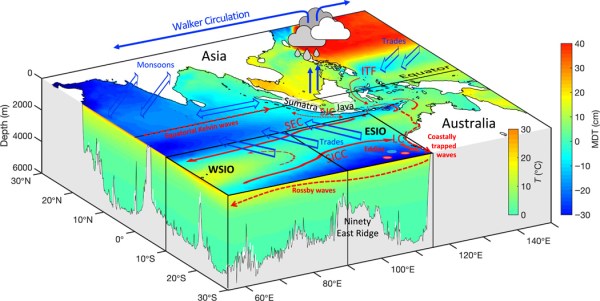
A decade-long increase of the basin-wide sea level and heat content in the subtropical southern Indian Ocean (SIO) during 2004–2013 ended abruptly, immediately following the onset of the strong 2014–2016 El Niño. Interestingly, this unprecedented drop of the SIO heat quickly recovered during the weak 2017–2018 La Niña. A study recently published in Science Advances... Continue Reading →
While the warming of northern hemisphere oceans almost stalled, the southern hemisphere oceans are heating up
Observations from Argo floats and satellite shows that the rate of global ocean warming during 2005-2015 is largely consistent with the climate simulations under the increasing greenhouse gas concentration. However, during that period, the southern hemisphere oceans have absorbed up to 98% of the net global ocean heat gain, while the warming of northern hemisphere... Continue Reading →
North Atlantic Ocean gyre circulation dictates the interannual sea level variability along the U.S. Southeast and Gulf Coasts
Interannual and longer time-scale sea level changes are relatively small amplitude. However, they can provide background conditions favorable for the occurrence of extreme sea levels that represent a threat for coastal communities, especially in low-lying and flood-vulnerable regions. A new study accepted in Geophysical Research Letters identified the dominant mode of the ocean gyre-scale sea surface height... Continue Reading →
Deep Indo-Pacific Oceans are still in the Little Ice Age
The Little Ice Age (LIA) is a period of cold global average surface temperatures from around 1600 to 1850, following the Medieval Warm Period (950 ~ 1250). A new study published in Science suggested that since the ocean adjusts to the surface thermal anomalies with the time scales of 100 ~ 1,000 years, some parts of the... Continue Reading →
Increasing water temperature tied to rapid sea level rise along the U.S. East Coast during 2010-2015
In a new article accepted for publication in the Geophysical Research Letters, Ricardo Domingues (CIMAS University of Miami & NOAA/AOML) and his coauthors explored the observed rapid sea level rise along the U.S. East Coasts during 2010-2015, which is linked to extensive flooding and “sunny day” flooding (or nuisance flooding) events in large urban areas including... Continue Reading →
Antarctic meltwater slows down global warming by more than a decade
A new study published in Nature used climate models to explore the effects of meltwater from the Antarctic ice sheets and ice shelves on global surface temperature under a warming climate. The study found that the increasing meltwater decreases the surface salinity of the Southern Ocean and thus increases the near-surface stratification, which in turn... Continue Reading →