Why Rising Seas Could Lower a Hurricane’s Peak Surge—But Drown a Wider Area

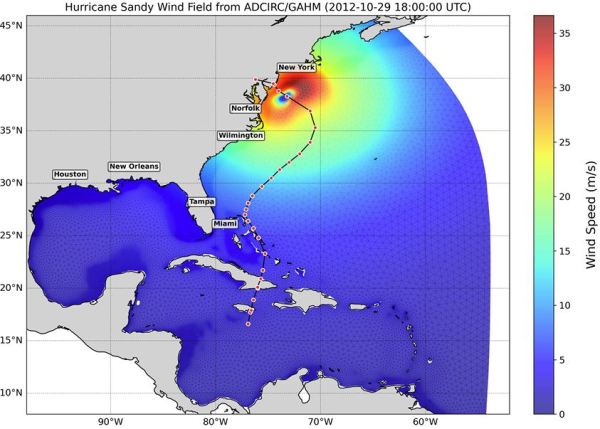
This blog post and the “Deep Dive” podcast, created by NotebookLM, are based on “Combined impacts of hurricane strengthening and global mean sea level rise on future Atlantic storm surge events” by Danso et al. (2025). It’s a scenario that seems frighteningly straightforward: as climate change causes sea levels to rise and hurricanes to strengthen,... Continue Reading →

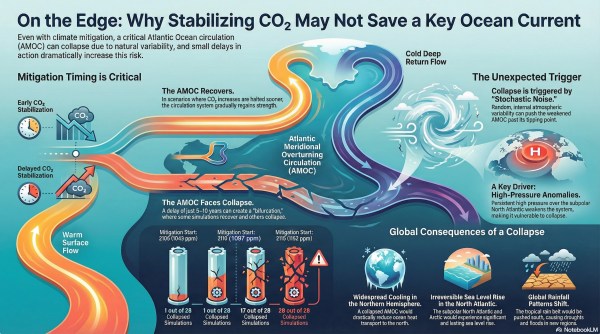
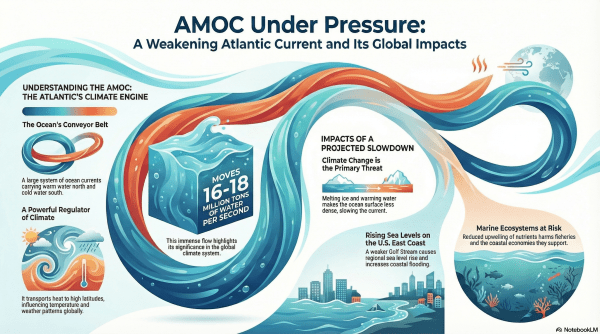
The Atlantic’s Weakening Pulse: How a Slowing Ocean Current Could Reshape Our Climate and Coasts

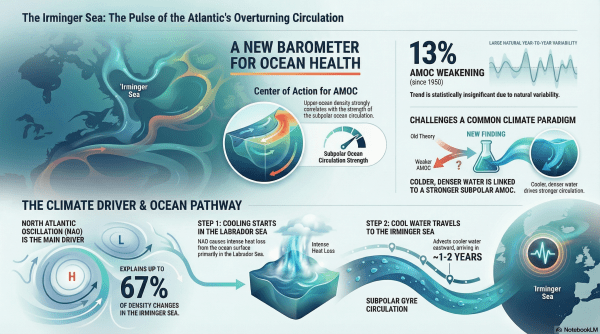
This blog post and the “Deep Dive” podcast, created by NotebookLM, are based on "State of the Science Fact Sheet: Atlantic Meridional Overturning Circulation (AMOC)" by NOAA Science Council. This NOAA fact sheet briefly explains the Atlantic Meridional Overturning Circulation (AMOC), defining it as a critical ocean current that transports heat, salt, and carbon by... Continue Reading →

A Climate ‘Tug-of-War’ Has Paused the Atlantic Current’s Slowdown

This blog post and the “Deep Dive” podcast on a paper “A pause in the weakening of the Atlantic meridional overturning circulation since the early 2010s” by Lee et al. (2024) was created by NotebookLM. Deep Dive Podcast “Atlantic Current Stability Is Borrowed Time” powered by NotebookLM: Introduction: The Ocean's Alarming Story Just Got More... Continue Reading →

Future strengthening of the Antarctic Slope Current and its potential implications for global sea level rise

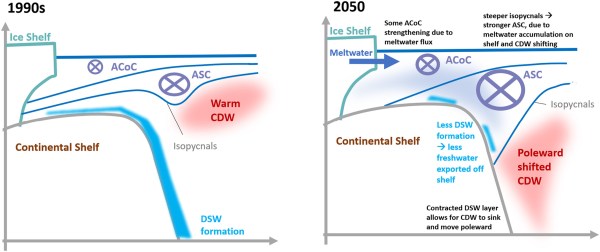
The Antarctic Slope Current (ASC) is the westward-flowing coastal current system around Antarctica, largely driven by easterly winds. It serves as a barrier to heat and salt exchanges between the cold, fresh Antarctic ice shelf region and the warm, salty Circumpolar Deep Water (CDW) in the Southern Ocean. A weakening of the ASC allows more... Continue Reading →

Human-induced weakening of the AMOC averted for now

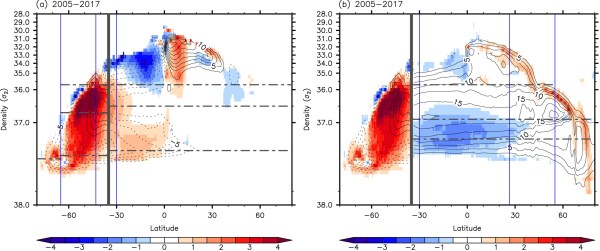
The current state-of-the-art climate models suggest that the human-induced weakening of the Atlantic Meridional Overturning Circulation (AMOC) has already begun since the mid-1980s. However, continuous direct observational records during the past two decades have shown no clear sign of a slowing down of the AMOC. To shed light on this apparent contradiction, a new study... Continue Reading →

Geomagnetic correction of submarine cable measurement revealed no significant trend in the Gulf Stream transport since 1982

The Florida Current (FC) refers to the Gulf Stream across the Florida Straits between Florida and the Bahamas. Its volume transport has been measured continuously since 1982 using submarine cables across the Florida Straits at 27°N by NOAA's Atlantic Oceanographic and Meteorological Laboratory (AOML). A previous study (Piecuch and Beal, 2023) reported that the FC... Continue Reading →

Is the AMOC shutting down soon?

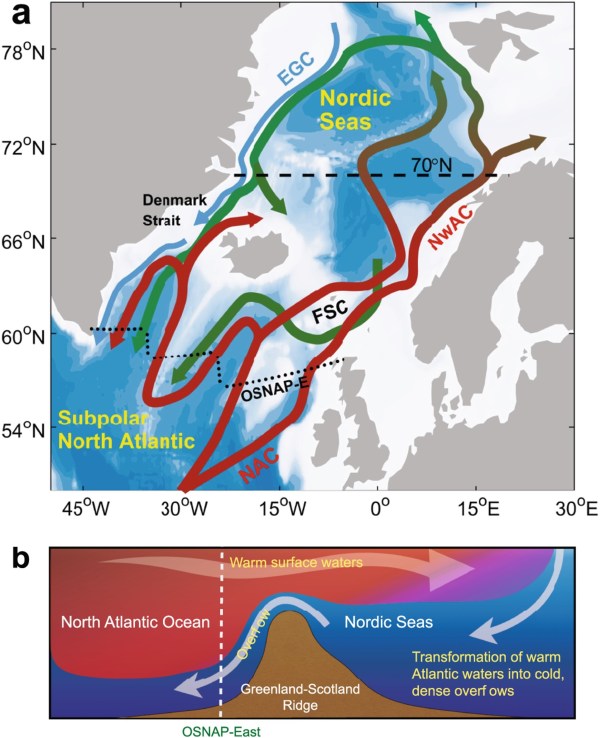
The Atlantic Meridional Overturning Circulation (AMOC) is the Atlantic component of the global ocean conveyor belt, which is a large-scale ocean circulation system that connects the Arctic, Atlantic, Indian, and Pacific Oceans via the Southern Ocean. Predominantly driven by deep convection in the high-latitude North Atlantic Ocean, the AMOC carries heat, salt, carbon, and other... Continue Reading →

Atlantic deep water is now warm enough to melt previously stable Greenland glacier

Ice sheet melting from Greenland's glaciers accounts for an increasing proportion of global sea level rise, losing ~330 billion tonnes of ice per year during 2006-2018 (compared to ~120 billion tonnes of ice per year during 1901-1990). A new study published in Nature Communications examined recent changes at K.I.V Steenstrups Nordre Bræ (66.53°N, 34.57°W), a... Continue Reading →

The Global Ocean Conveyor Belt is Reshaping from the Southern Ocean

As the surface ocean warms and polar ice sheets melt due to increasing anthropogenic greenhouse gases in the atmosphere, near-surface stratification is increasing almost everywhere, including the major deep water formation regions in the high-latitude North Atlantic and around Antarctica. As a result, the global Meridional Overturning Circulation (MOC), also known as the global ocean... Continue Reading →

Nearshore sea ice shield Antarctic ice shelves from the damaging impact of ocean waves

The Larsen ice shelves extend along the east coast of the Antarctic Peninsula over the northwest part of the Weddell Sea. From north to south, these segments are called the Larsen A, B, C, and D, bordered by Filchner–Ronne Ice Shelf south of the Weddell Sea. In 1995, the Larsen A ice shelf completely disintegrated,... Continue Reading →

Website Powered by WordPress.com.

Up ↑