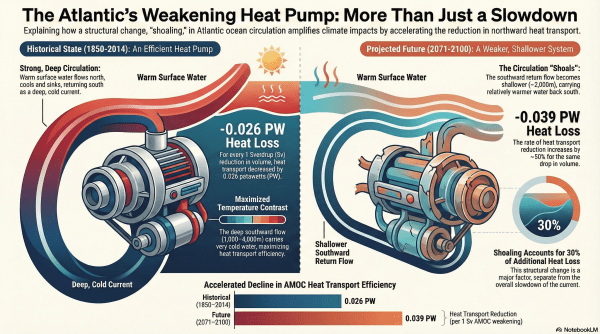
A Climate ‘Tug-of-War’ Has Paused the Atlantic Current’s Slowdown

This blog post and the “Deep Dive” podcast on a paper “A pause in the weakening of the Atlantic meridional overturning circulation since the early 2010s” by Lee et al. (2024) was created by NotebookLM. Deep Dive Podcast “Atlantic Current Stability Is Borrowed Time” powered by NotebookLM: Introduction: The Ocean's Alarming Story Just Got More... Continue Reading →

Seasonal outlook of hurricane activity for five North Atlantic sub-basins

Seasonal hurricane outlooks, such as those issued by NOAA's Climate Prediction Center, Colorado State University (Klotzbach et al., 2017), European Center for Medium-Range Weather Forecasts, and University of Arizona (Davis and Zeng, 2019), produce skillful (i.e.,. better than climatology) seasonal forecasts of overall North Atlantic tropical cyclone (TC) activity. Such forecasts are possible because seasonal... Continue Reading →

Synergy effect of warm Atlantic-Pacific on the longest-lasting 2023 western North American heat wave

The southwestern United States (US) and Northern Mexico experienced their longest stretch of record-breaking heat wave in the summer of 2023 from mid-June to early August, affecting over 100 million people, causing over 200 deaths, and $14.5 billion in economic loss. In Phoenix, Arizona, for example, the heat wave lasted for 31 days from 30... Continue Reading →

Onset of 2025 Atlantic Niña and its implication for typhoon landfalling risks in East and Southeast Asian countries

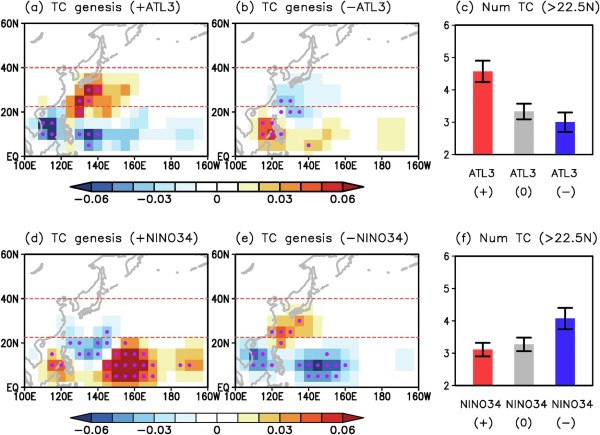
Atlantic Niña is a natural climate pattern characterized by cooler-than-average sea surface temperatures in the eastern equatorial Atlantic Ocean, appearing predominantly in June-August. It is considered the 'cold phase' of the Atlantic Zonal Mode, the leading mode of tropical Atlantic sea surface temperature variability in June-August, similar to how La Niña is the cold phase... Continue Reading →

Human-induced weakening of the AMOC averted for now

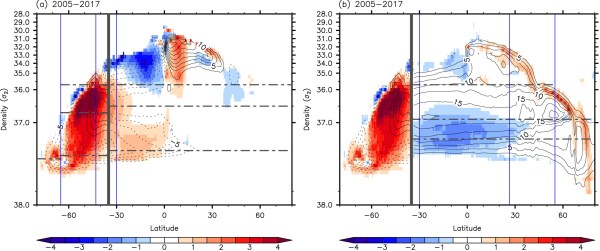
The current state-of-the-art climate models suggest that the human-induced weakening of the Atlantic Meridional Overturning Circulation (AMOC) has already begun since the mid-1980s. However, continuous direct observational records during the past two decades have shown no clear sign of a slowing down of the AMOC. To shed light on this apparent contradiction, a new study... Continue Reading →

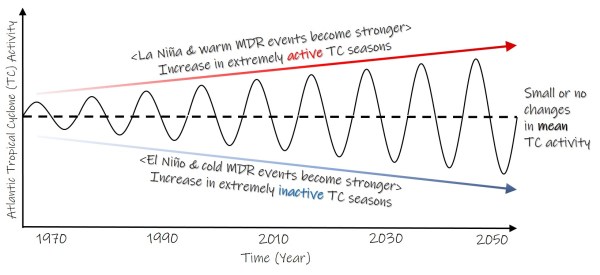
Storm-resolving climate models project a 36% increase in the year-to-year variability of Atlantic hurricane activity by the 2050s

Tropical cyclone (TC) activity results in substantial loss of life and property damage. While the Atlantic basin has experienced a pronounced increase in accumulated cyclone energy (ACE) and the number of TCs over the past 50 years, TC-resolving climate models project a slight decrease in TC frequency throughout the 21st century (e.g., Roberts et al.,... Continue Reading →

Human-induced ozone depletion has acted to enhance the La Niña-like SST trend pattern

During the satellite era (1979-present), the tropical Pacific Ocean has warmed significantly less than the other tropical oceans in response to increasing greenhouse gases (GHGs). This La Niña-like warming trend in observations is in disagreement with the El Niño-like warming trend projected by the Coupled Model Intercomparison Project (CMIP) models for both the 20th and... Continue Reading →

Quad-State Tornado Outbreaks promoted by a long-lived PNA

On December 10, 2021, one of the most destructive winter tornado outbreaks developed in northeastern Arkansas. This tornado outbreak, later coined as the Quad-State Tornado Outbreaks by the news media, struck portions of the Ohio Valley, including Missouri, Illinois, Tennessee, and Kentucky, from December 10 to 11, 2021. According to the National Oceanic and Atmospheric... Continue Reading →

MJO-driven onset of the 2021 Atlantic Niño

Atlantic Niño is the Atlantic counterpart of El Niño in the Pacific, often referred to as El Niño's little brother. It was previously thought to have only regional influence on rainfall variability in West Africa, but a growing number of studies have shown that Atlantic Niño also plays an important role in the development of... Continue Reading →

El Niño’s little brother in the Atlantic may not be so little when it comes to its impact on hurricanes

Atlantic Niño, characterized by warm sea surface temperature (SST) anomalies in the eastern equatorial Atlantic, is the Atlantic counterpart of the Pacific El Niño. Due to its smaller size in zonal extent, it is often referred to as El Niño’s little brother. It was previously thought to have a limited regional influence on rainfall variability... Continue Reading →

Website Powered by WordPress.com.

Up ↑