
An article published in Science analyzed GPS station data collected around the West Antarctica to report a rapid uplift of the Amundsen Sea Embayment in response to ice mass loss during the recent decades. This suggests that as ice mass is lost, the crust rebounds much faster than previously expected (thought to occur on a time scale of 10,000 years)... Continue Reading →
A coastal coccolithophore species (O. neapolitana) maintains pH homeostasis and switches carbon sources in response to ocean acidification
According to a new article published in Nature Communications, a coastal coccolithophore species (Ochrosphaera neapolitana), which has a unique mechanism for producing coccoliths, can maintains constant pH at the calcification site, regardless of CO2-induced changes in pH of the surrounding seawater. The authors of this study cultured a coccolithophore species (Ochrosphaera neapolitana), the most prolific ocean calcifiers in the ocean, under three pCO2-controlled... Continue Reading →
Global surface warming enhanced by weak Atlantic overturning circulation
Palaeoceanographic records indicate that abrupt cooling of Northern Hemisphere during deglacial periods are linked to weakening of the Atlantic Meridional Overturning Circulation (AMOC). However, a new article published in Nature argues that during a weak state of the AMOC, ocean heat is released to the atmosphere increasing the global surface temperature. This study further suggests that during... Continue Reading →
Antarctica and the Southern Ocean in 2070, under low and high emissions scenarios

A team of experts in biology, oceanography, glaciology, geophysics, climate science and policy, analyzed the potential impacts of two different future scenarios of carbon emissions, RCP2.6 (low emission & strong action) and RCP 8.5 (high emission & weak action), on Antarctica and the Southern Ocean. The team assessed key systems including global average air temperature; Antarctic contribution... Continue Reading →
Antarctic ice sheet lost 2,720 ± 1,390 billion tonnes of ice between 1992 and 2017
A team of scientists leading the ice sheet mass balance inter-comparison exercise (IMBIE) combined satellite observations of the Antarctic ice sheet, its changing volume, flow and gravitational attraction with modelling of its surface mass balance from 1992 to 2017. Their report, recently published in Nature, showed that the Antarctic ice sheet lost 2,720 ± 1,390 billion tonnes of... Continue Reading →
Antarctic ice shelf disintegration triggered by sea ice loss and ocean swell

Understanding the causes of recent catastrophic ice shelf disintegrations is a crucial step towards improving coupled models of the Antarctic Ice Sheet and predicting its future state and contribution to sea-level rise. An overlooked climate-related causal factor is regional sea ice loss. Here we show that for the disintegration events observed (the collapse of the... Continue Reading →
Man-made nutrient pollution could make coral reefs more vulnerable to ocean acidification
A team of scientists from California State University and University of Hawaii carried out a series of laboratory experiments adding nitrate and phosphate to aquariums that contain the coral reef community (corals, seaweeds and dead reef rubble). Their experiments showed that in nutrient polluted seawater, the calcification by coral reefs became less effective disrupting the relationship between... Continue Reading →
Sustained climate warming drives declining marine biological productivity
In the Southern Ocean, nutrient-rich North Atlantic Deep Water upwells to the surface, and the northward surface water sinks at mid-depth (as Subantarctic Mode Water and Antarctic Intermediate Water) and transports nutrients into the low-latitude thermocline. According to a recent article appeared in Science, climate model simulations under RCP 8.5 scenario project that the Antarctic... Continue Reading →
Antarctic volcanic eruption linked to the onset of the most rapid global climate change during the end of the last ice age
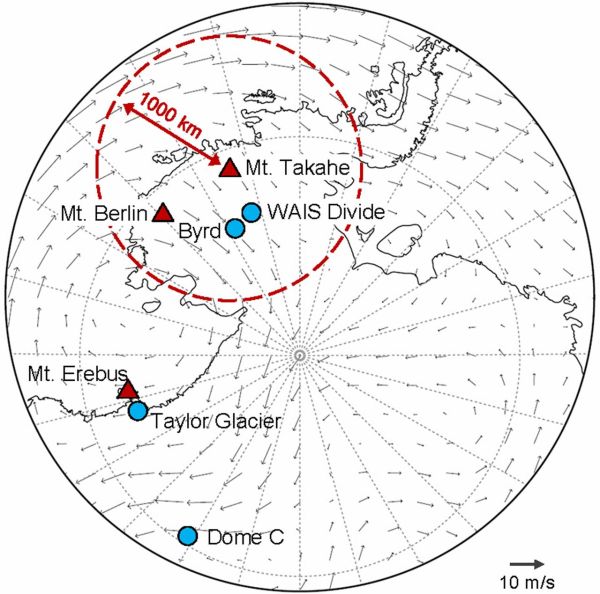
Cold and dry glacial-state climate conditions persisted in the Southern Hemisphere until approximately 17.7 ka, when paleoclimate records show a largely unexplained sharp, nearly synchronous acceleration in deglaciation. Detailed measurements in Antarctic ice cores document exactly at that time a unique, ∼192-y series of massive halogen-rich volcanic eruptions geochemically attributed to Mount Takahe in West... Continue Reading →
Hurricane Harvey links to ocean heat content and climate change adaptation
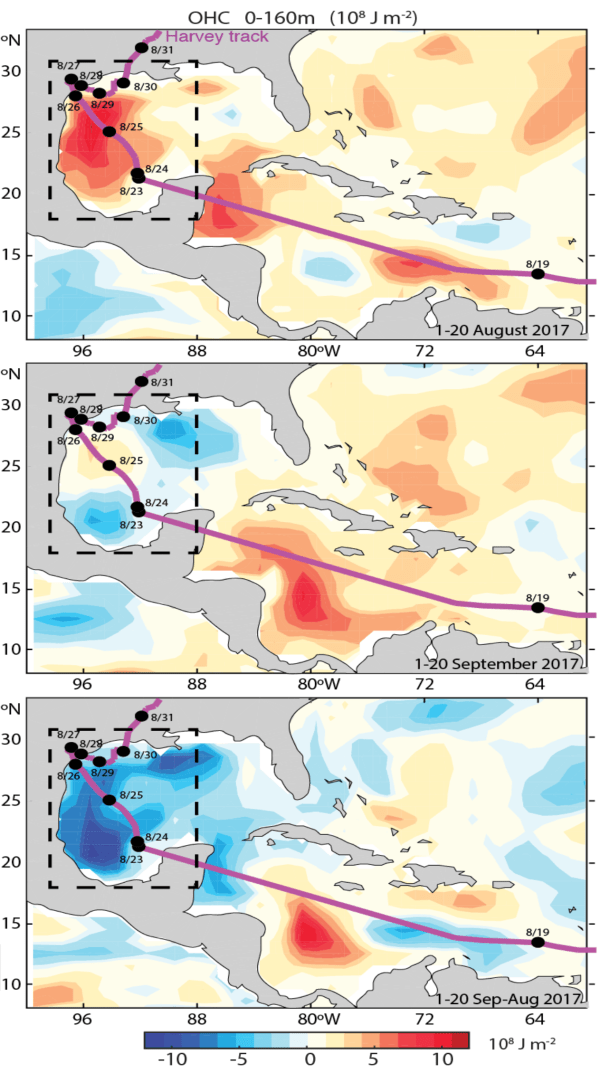
While hurricanes occur naturally, human‐caused climate change is supercharging them and exacerbating the risk of major damage. Here, using ocean and atmosphere observations, we demonstrate links between increased upper ocean heat content due to global warming with the extreme rainfalls from recent hurricanes. Hurricane Harvey provides an excellent case study as it was isolated in... Continue Reading →
 Ocean to Climate