A Collapse Of The AMOC Would Drastically Alter Global Monsoons

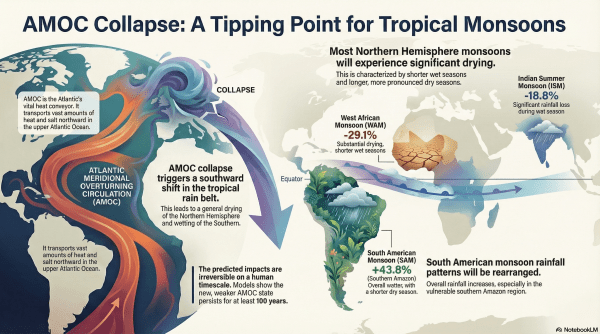
This blog post and the “Deep Dive” podcast, created by NotebookLM, are based on “Impacts of AMOC Collapse on Monsoon Rainfall: A Multi‐Model Comparison” by Ben-Yami et al. (2024). Summary: Ben-Yami et al. (2024) analyzes how a potential collapse of the Atlantic Meridional Overturning Circulation (AMOC) would drastically alter tropical monsoon rainfall patterns worldwide. By... Continue Reading →

The Atlantic’s Weakening Pulse: How a Slowing Ocean Current Could Reshape Our Climate and Coasts

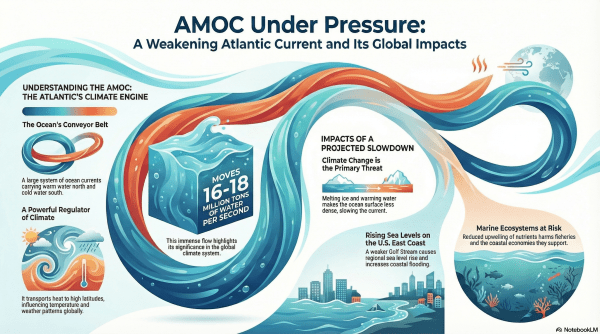
This blog post and the “Deep Dive” podcast, created by NotebookLM, are based on "State of the Science Fact Sheet: Atlantic Meridional Overturning Circulation (AMOC)" by NOAA Science Council. This NOAA fact sheet briefly explains the Atlantic Meridional Overturning Circulation (AMOC), defining it as a critical ocean current that transports heat, salt, and carbon by... Continue Reading →

TWISO is a tropics-wide 45-day pulse and does not requires MJO

This blog post and the “Deep Dive” podcast on a paper “Tropics-wide intraseasonal oscillations” by Bao et al. (2025) was created by NotebookLM. Deep Dive Podcast “Earth's Global Climate Heartbeat The TWISO Cycle” powered by NotebookLM: 1.0 Introduction: The Stable Tropics Aren't So Stable When we think about the climate of the tropics, we tend... Continue Reading →

Synergy effect of warm Atlantic-Pacific on the longest-lasting 2023 western North American heat wave

The southwestern United States (US) and Northern Mexico experienced their longest stretch of record-breaking heat wave in the summer of 2023 from mid-June to early August, affecting over 100 million people, causing over 200 deaths, and $14.5 billion in economic loss. In Phoenix, Arizona, for example, the heat wave lasted for 31 days from 30... Continue Reading →

Onset of 2025 Atlantic Niña and its implication for typhoon landfalling risks in East and Southeast Asian countries

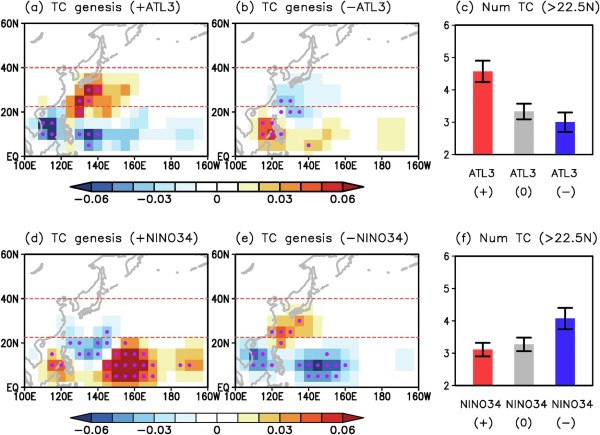
Atlantic Niña is a natural climate pattern characterized by cooler-than-average sea surface temperatures in the eastern equatorial Atlantic Ocean, appearing predominantly in June-August. It is considered the 'cold phase' of the Atlantic Zonal Mode, the leading mode of tropical Atlantic sea surface temperature variability in June-August, similar to how La Niña is the cold phase... Continue Reading →

Increasing ocean stratification intensifies sea surface temperature variability

As the surface ocean warms and polar ice sheets melt due to increasing anthropogenic greenhouse gases in the atmosphere, near-surface ocean stratification is increasing almost everywhere. In tropical and subtropical oceans, in particular, enhanced near-surface stratification inhibits the mixing between warmer surface water and cooler subsurface water, leading to a shallower surface mixed layer. In... Continue Reading →

Java-Sumatra Niño/Niña: two long-lost siblings of El Niño

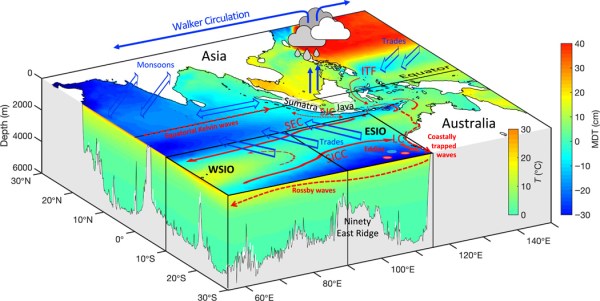
There are many siblings, cousins, and distant relatives of El Niño spanning the Pacific, Atlantic, and Indian Oceans who share a feature in common: ocean surface temperature anomalies along eastern boundaries linked to changes in the upwelling of cooler water from below. So far, climate scientists have identified a total of 14 members of this... Continue Reading →

Future El Niño events will develop faster and persist longer

Previous studies based on the climate models participating in the Coupled Model Intercomparison Project (CMIP) have suggested an increase in the frequency of extreme El Niño events in the 21st Century in response to increasing greenhouse gases. Several studies have attributed these shifts in El Niño frequency and amplitude to the projected changes in the... Continue Reading →

What caused the abrupt reduction of the South Indian Ocean heat & sea level in 2014–2016 and the ensuing quick recovery?

A decade-long increase of the basin-wide sea level and heat content in the subtropical southern Indian Ocean (SIO) during 2004–2013 ended abruptly, immediately following the onset of the strong 2014–2016 El Niño. Interestingly, this unprecedented drop of the SIO heat quickly recovered during the weak 2017–2018 La Niña. A study recently published in Science Advances... Continue Reading →

Extreme U.S. Great Plains heat waves are linked to East Asian Monsoon

Heat waves are the leading weather‐related cause of death in the U.S. For example, the most recent U.S. extreme heat waves that occurred over the Great Plains in 2011 and 2012 caused 362 deaths. These events are unusual and largely unpredictable beyond the synoptic time scale. However, their number and severity have increased and are projected... Continue Reading →

Website Powered by WordPress.com.

Up ↑