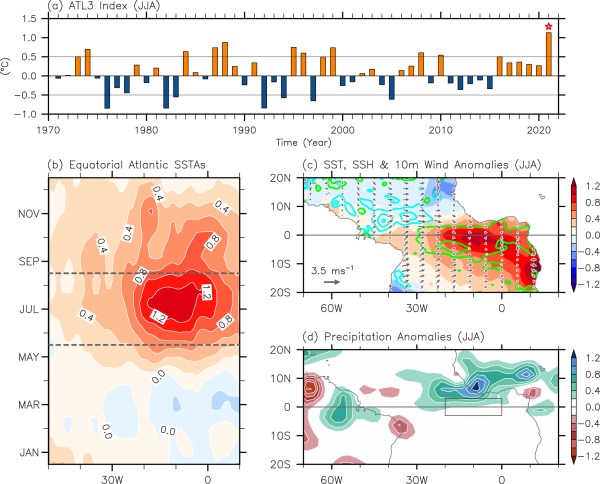
Currently (as of June 22, 2024), a phenomenon known as Atlantic Niña is brewing in the tropical Atlantic Ocean. As the Atlantic counterpart of La Niña in the Pacific, Atlantic Niña is characterized by the appearance of cold sea surface temperature anomalies (SSTAs) in the eastern equatorial Atlantic. It is known to reduce rainfall and... Continue Reading →
MJO-driven onset of the 2021 Atlantic Niño
Atlantic Niño is the Atlantic counterpart of El Niño in the Pacific, often referred to as El Niño's little brother. It was previously thought to have only regional influence on rainfall variability in West Africa, but a growing number of studies have shown that Atlantic Niño also plays an important role in the development of... Continue Reading →
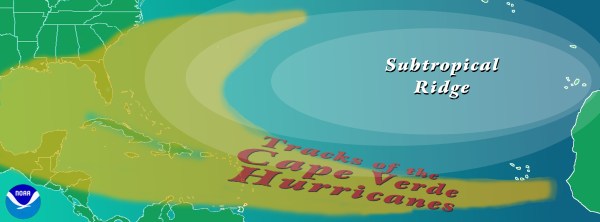
El Niño’s little brother in the Atlantic may not be so little when it comes to its impact on hurricanes
Atlantic Niño, characterized by warm sea surface temperature (SST) anomalies in the eastern equatorial Atlantic, is the Atlantic counterpart of the Pacific El Niño. Due to its smaller size in zonal extent, it is often referred to as El Niño’s little brother. It was previously thought to have a limited regional influence on rainfall variability... Continue Reading →
Future El Niño events will develop faster and persist longer
Previous studies based on the climate models participating in the Coupled Model Intercomparison Project (CMIP) have suggested an increase in the frequency of extreme El Niño events in the 21st Century in response to increasing greenhouse gases. Several studies have attributed these shifts in El Niño frequency and amplitude to the projected changes in the... Continue Reading →
ENSO plays little role in early-season Atlantic hurricane activity
This is a guest blog by Robert West. Robert is a postdoctoral research associate in the Northern Gulf Institute (NGI) at the Mississippi State University and is also affiliated with NOAA's Atlantic Oceanographic and Meteorological Laboratory. Differences in sea surface temperature anomalies (SSTAs) between the tropical Atlantic and Pacific oceans are known to influence atmospheric... Continue Reading →
North Atlantic Tropical Cyclones have become increasingly likely to “stall” near the coast
Hurricane Dorian was a powerful storm that reached a maximum sustained wind of 185 mph (Cat 5 ≥ 157 mph) during its landfall over Abaco Islands on September 1, 2019. Hurricane Dorian made landfall on Grand Bahama with about the same intensity and stalled just north of the island for 24 hours, causing massive damages... Continue Reading →
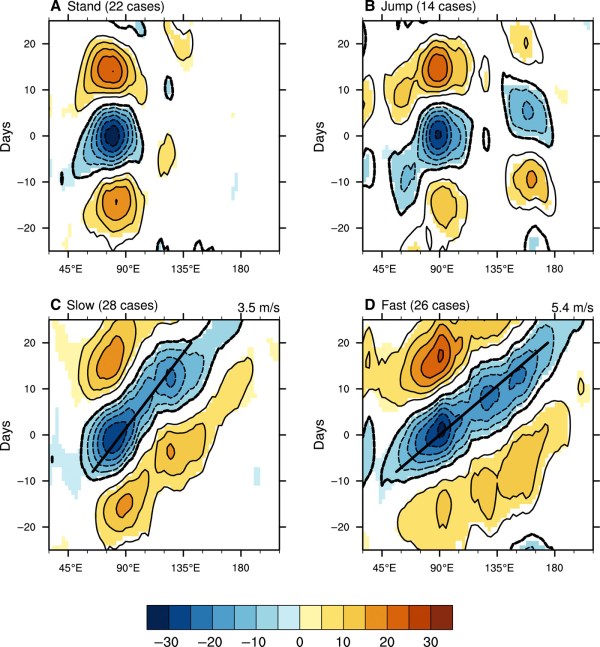
Four types of the Madden-Julian Oscillation
Madden-Julian Oscillation (MJO) is the main mode of intraseasonal atmospheric variability in the tropical Indo-Pacific Oceans and the major source of subseasonal predictability of precipitation and extreme weather events in many parts of the globe. Although MJO is known as an eastward propagating equatorial atmospheric kelvin wave, not all MJO events are identical in terms of their strength... Continue Reading →
Pantropical inter-ocean interactions & the rising influence of tropical Atlantic Ocean
Conventional view so far has been that El Nino - Southern Oscillation (ENSO) is largely responsible for energizing the dominant modes of SST variability in the tropical Atlantic and Indian Oceans through changes in the Walker circulation and extratropical atmospheric waves. However, recent studies have shown that SST variability in the tropical Atlantic and Indian... Continue Reading →
Ocean precursors to the extreme Atlantic 2017 hurricane season
A recent study published in nature communications investigated three ocean precursors, namely surface latent heat flux and wind stress curl over the main development region (MDR, 10–20°N, 20–80°W) and the Atlantic Meridional Overturning Circulation (AMOC) at 26.5°N, to the active hurricane seasons in 2005, 2010 and 2017. The study showed that in 2005 and 2010, a weakened... Continue Reading →
May 24, 2018 – NOAA’s Climate Prediction Center predict a near- or above-normal 2018 Atlantic hurricane season
NOAA’s forecasters predict a 70-percent likelihood of 10 to 16 named storms (winds of 39 mph or higher), of which 5 to 9 could become hurricanes (winds of 74 mph or higher), including 1 to 4 major hurricanes (category 3, 4 or 5; with winds of 111 mph or higher). An average hurricane season produces 12 named storms,... Continue Reading →