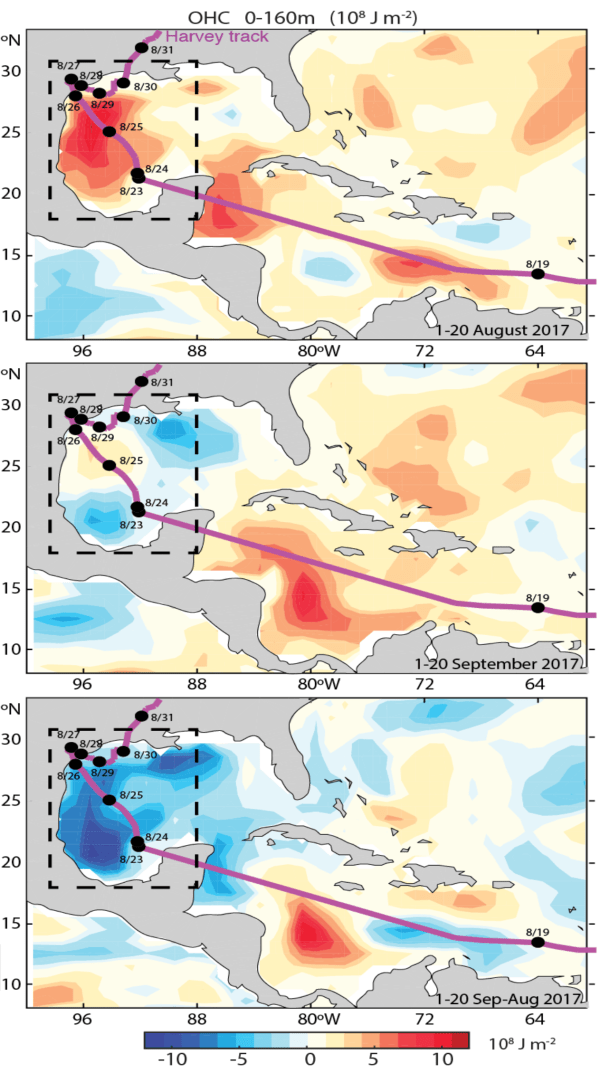
While hurricanes occur naturally, human‐caused climate change is supercharging them and exacerbating the risk of major damage. Here, using ocean and atmosphere observations, we demonstrate links between increased upper ocean heat content due to global warming with the extreme rainfalls from recent hurricanes. Hurricane Harvey provides an excellent case study as it was isolated in... Continue Reading →
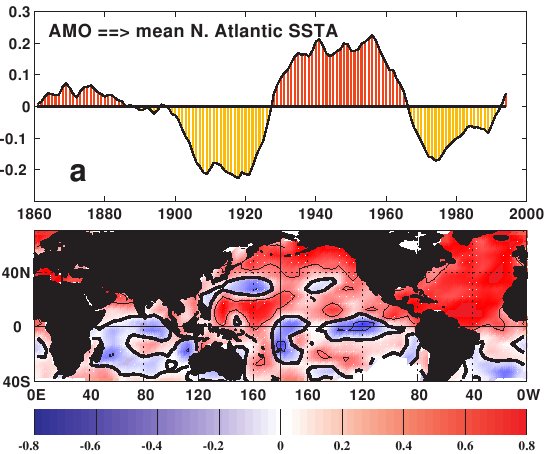
Ocean dynamics plays a key role in driving the Atlantic Multidecadal Oscillation (AMO)
The recently proposed atmosphere-forced thermodynamics mechanism of the AMO challenged the well-known ocean dynamics mechanism, and thus it is important to identify a key feature associated with the AMO that can be used to distinguish between the two mechanisms. In this study, the spatial structure of AMO is analyzed and compared between the observations and... Continue Reading →
Northward shift of the East Asian summer monsoon enhances US summer rainfall variability
The strength of the dominant variability of contiguous United States (CONUS) summer rainfall during 1960–2013 experiences an interdecadal change in the early 1990s. Before the early 1990s, the variation in CONUS summer rainfall is relatively small in amplitude (standard deviation: 0.64 mm per day), whereas after it amplifies remarkably, with its standard deviation (1.31 mm... Continue Reading →
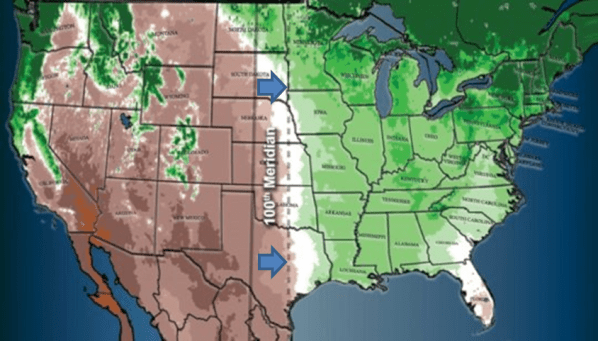
The boundary that separates the humid East US from the semi-arid West is shifting eastward
The 100th meridian bisects the Great Plains of the United States and effectively divides the continent into more arid western and less arid eastern halves and is well expressed in terms of vegetation, land hydrology, crops, and the farm economy. Here, it is considered how this arid–humid divide will change in intensity and location during... Continue Reading →
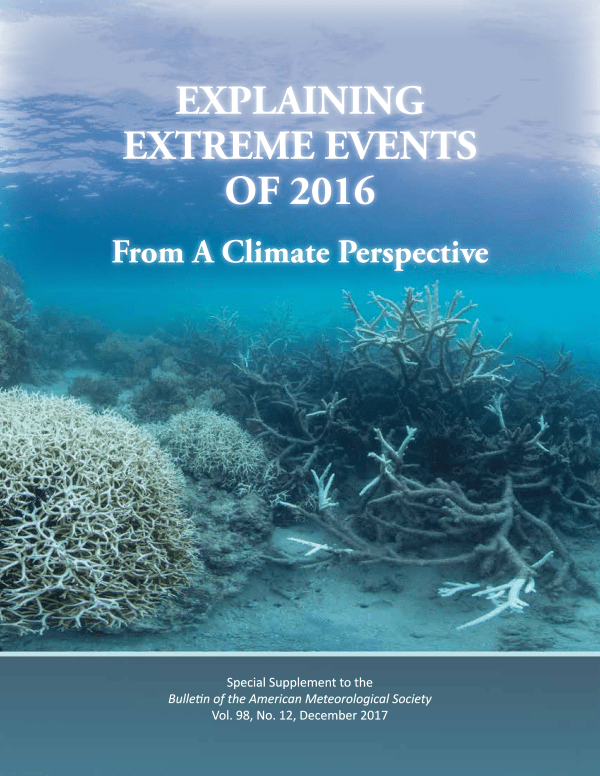
Explaining extreme events from a climate perspective
This special report of the Bulletin of the American Meteorological Society (BAMS) presents some extreme events in 2016, such as the record global heat, the heat across Asia, the 2015-16 El Niño and a marine heat wave off the coast of Alaska, and discusses how human-caused climate change may have affected the strength and likelihood of these extreme events.... Continue Reading →
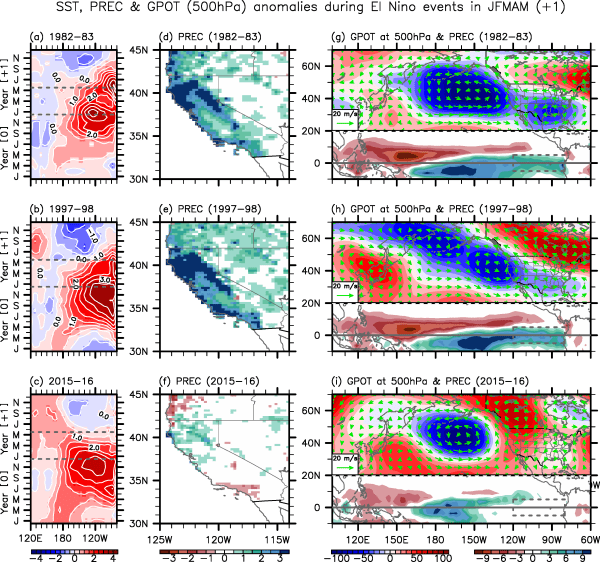
On the fragile relationship between El Niño and California rainfall
This study newly accepted in Geophysical Research Letters examined why California experienced extremely wet winter and spring conditions during the 1997-98 and 1982-83 El Niños, but near normal rainfall during the extremely strong 2015-16 El Niño. Statistical data analyses and simple model experiments were used to show that sufficiently warm and persistent sea surface temperature anomalies... Continue Reading →
Increased rainfall volume from future convective storms in the US
Mesoscale convective system (MCS)-organized convective storms with a size of ~100 km have increased in frequency and intensity in the USA over the past 35 years, causing fatalities and economic losses. However, their poor representation in traditional climate models hampers the understanding of their change in the future. Here, a North American-scale convection-permitting model which is... Continue Reading →