More Than an Emission: How Rising Waste Heat Are Cooking North America

This blog post and the “Deep Dive” podcast, created by NotebookLM, are based on “Energy‐Consumption‐Induced Anthropogenic Heat Release Intensifies Heatwaves and Wildfire Threats in North America: A CESM2‐Based Projection for the Late 21st Century” by Wang et al. (2025). When we talk about climate change, the conversation almost invariably turns to greenhouse gases. Carbon dioxide,... Continue Reading →

Synergy effect of warm Atlantic-Pacific on the longest-lasting 2023 western North American heat wave

The southwestern United States (US) and Northern Mexico experienced their longest stretch of record-breaking heat wave in the summer of 2023 from mid-June to early August, affecting over 100 million people, causing over 200 deaths, and $14.5 billion in economic loss. In Phoenix, Arizona, for example, the heat wave lasted for 31 days from 30... Continue Reading →

Increasing frequency of “moist” heatwaves

Heatwaves usually come with dry conditions because the regions under the so-called heat dome, which is typically responsible for severe heatwave events, are deprived of moisture and rainfall. However, in the southern US states under semi-tropical environments, "moist" heatwave events may occur, causing both the temperature and humidity stresses on human physiology. But, you may... Continue Reading →

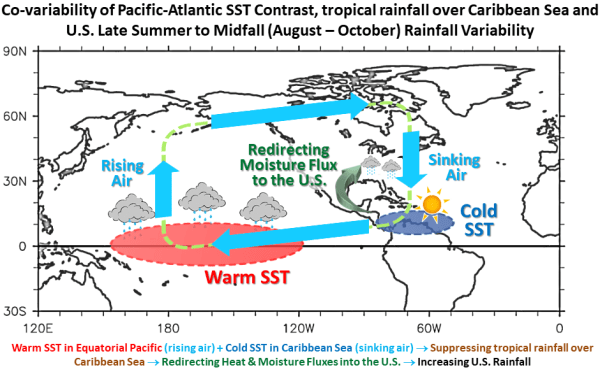
Co-variability of Pacific‐Atlantic SST contrast, Caribbean Sea tropical rainfall and U.S. summer to fall rainfall variability

In the U.S., peak summer (June-July) rainfall variability, especially east of the Rockies, is largely linked to North Atlantic sea surface temperature (SST) anomalies and associated variations in the Bermuda High. However, these well-established relationships almost completely break down in late summer to mid fall (August-October). Thus, operational seasonal forecast models have generally low skill... Continue Reading →

Extreme U.S. Great Plains heat waves are linked to East Asian Monsoon

Heat waves are the leading weather‐related cause of death in the U.S. For example, the most recent U.S. extreme heat waves that occurred over the Great Plains in 2011 and 2012 caused 362 deaths. These events are unusual and largely unpredictable beyond the synoptic time scale. However, their number and severity have increased and are projected... Continue Reading →

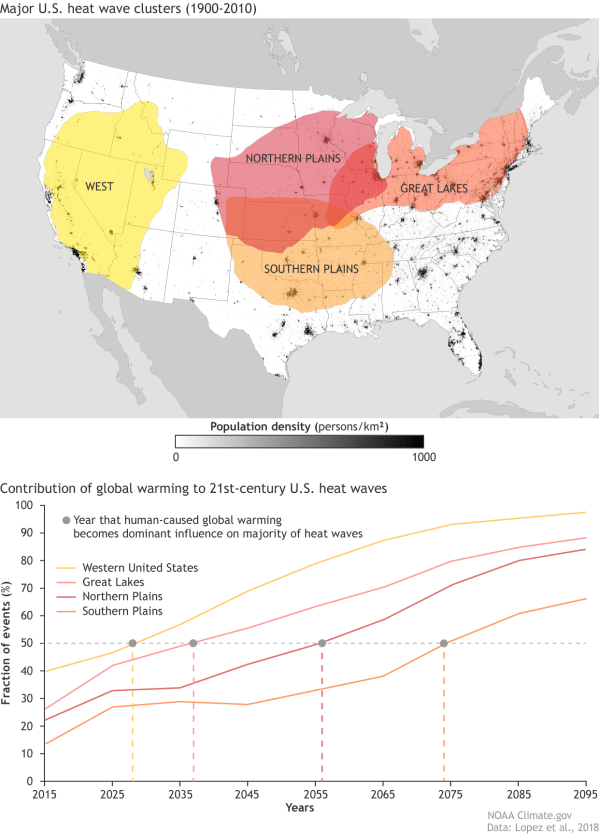
Influence of global warming on U.S. heat waves may be felt first in the West and Great Lakes regions

Climate projections for the twenty-first century suggest an increase in the occurrence of heat waves. However, the time at which externally forced signals of anthropogenic climate change (ACC) emerge against background natural variability (time of emergence (ToE)) has been challenging to quantify, which makes future heat-wave projections uncertain. Here we combine observations and model simulations... Continue Reading →

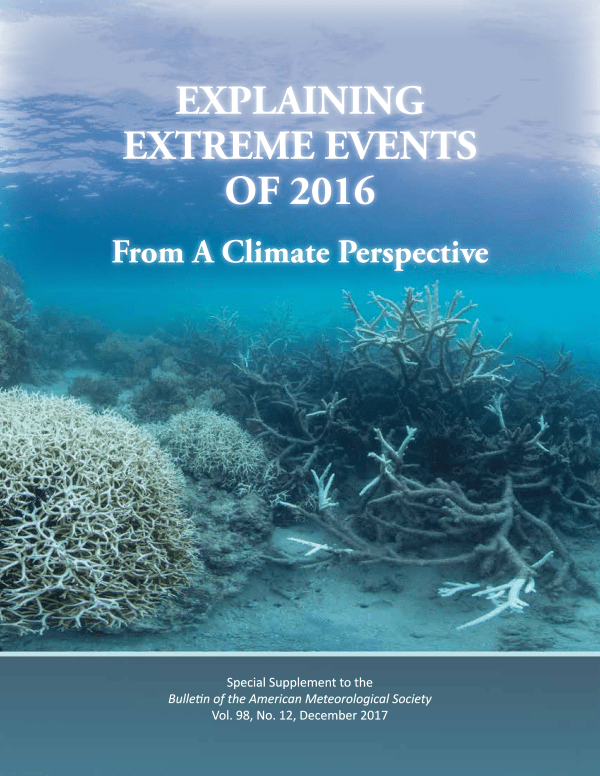
Explaining extreme events from a climate perspective

This special report of the Bulletin of the American Meteorological Society (BAMS) presents some extreme events in 2016, such as the record global heat, the heat across Asia, the 2015-16 El Niño and a marine heat wave off the coast of Alaska, and discusses how human-caused climate change may have affected the strength and likelihood of these extreme events.... Continue Reading →

Highlights of the findings of the U.S. global change research program climate science special report

This executive summary presents the Fourth National Climate Assessment (NCA4), an authoritative assessment of the science of climate change, with a focus on the United States. This represents the first of two volumes of the Fourth National Climate Assessment, mandated by the Global Change Research Act of 1990. https://science2017.globalchange.gov/chapter/executive-summary/

Website Powered by WordPress.com.

Up ↑