A Critical Ocean Carbon Sink May Reverse, Forming a “CO2 Uptake Hole”

This blog post and the “Deep Dive” and "Critique " podcasts, created by NotebookLM, are based on “Emergence of an oceanic CO2 uptake hole under global warming” by Huiji Lee et al. (2025). Deep Dive Podcast “North Atlantic Carbon Sink Reverses Near-Term” powered by NotebookLM: Two hosts provide a critical analysis and constructive feedback to... Continue Reading →

Solving the Mystery of the Great Atlantic Sargassum Belt: 5 Surprising Truths

This blog post and the “Deep Dive” podcast, created by NotebookLM, are based on “Equatorial upwelling of phosphorus drives Atlantic N2 fixation and Sargassum blooms" by Jung et al. (2025). Deep Dive Podcast “Climate History Solves Sargassum Crisis”: Introduction: The Golden Tide Mystery Since 2011, a mysterious phenomenon has plagued the coastlines of the Caribbean,... Continue Reading →

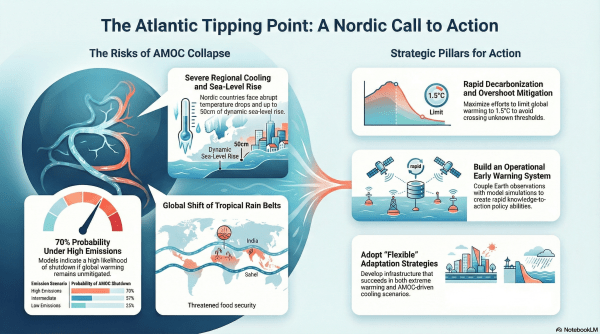
The Atlantic’s Weakening Pulse: How a Slowing Ocean Current Could Reshape Our Climate and Coasts

This blog post and the “Deep Dive” podcast, created by NotebookLM, are based on "State of the Science Fact Sheet: Atlantic Meridional Overturning Circulation (AMOC)" by NOAA Science Council. This NOAA fact sheet briefly explains the Atlantic Meridional Overturning Circulation (AMOC), defining it as a critical ocean current that transports heat, salt, and carbon by... Continue Reading →

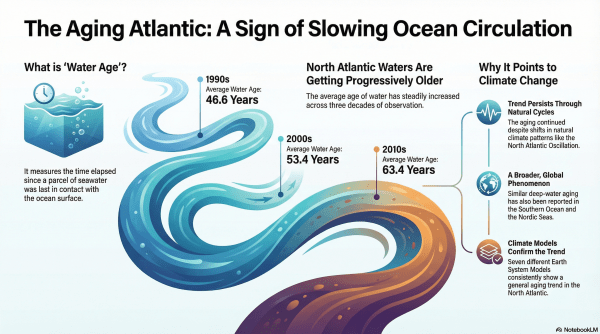
A Climate ‘Tug-of-War’ Has Paused the Atlantic Current’s Slowdown

This blog post and the “Deep Dive” podcast on a paper “A pause in the weakening of the Atlantic meridional overturning circulation since the early 2010s” by Lee et al. (2024) was created by NotebookLM. Deep Dive Podcast “Atlantic Current Stability Is Borrowed Time” powered by NotebookLM: Introduction: The Ocean's Alarming Story Just Got More... Continue Reading →

A note on the potential AMOC collapse for nonexperts

As the Earth warms due to anthropogenic climate change, sea- and land-based ice melts, adding buoyant freshwater to the surface of the high-latitude North Atlantic and thus decreasing salinity. This makes the surface water lighter reducing the sinking of the surface water and thus the AMOC. However, the amount of added freshwater is not enough... Continue Reading →

Human-induced weakening of the AMOC averted for now

The current state-of-the-art climate models suggest that the human-induced weakening of the Atlantic Meridional Overturning Circulation (AMOC) has already begun since the mid-1980s. However, continuous direct observational records during the past two decades have shown no clear sign of a slowing down of the AMOC. To shed light on this apparent contradiction, a new study... Continue Reading →

France’s floating ocean laboratory is a future hub of international Arctic research collaboration

As of 2024, there are currently 70 permanent research stations from 29 countries scattered around the continent of Antarctica conducting important scientific research to better understand the Earth system and its changes due to human activity. In the Arctic, however, there are no such permanent research stations because there is no land in the Arctic.... Continue Reading →

The Global Ocean Conveyor Belt is Reshaping from the Southern Ocean

As the surface ocean warms and polar ice sheets melt due to increasing anthropogenic greenhouse gases in the atmosphere, near-surface stratification is increasing almost everywhere, including the major deep water formation regions in the high-latitude North Atlantic and around Antarctica. As a result, the global Meridional Overturning Circulation (MOC), also known as the global ocean... Continue Reading →

Antarctic Bottom Water (AABW) export pathways across the Southern Ocean

The Antarctic Bottom Water (AABW) is the densest water mass of the global ocean that covers about 30 ~ 40% of the global ocean volume with temperatures ranging from -0.8 to 2°C and salinities from 34.6 to 34.7 psu. It forms around Antarctica and spreads into the Southern Ocean and then into the Atlantic, Indian,... Continue Reading →

New aircraft-based observations confirm the role of the Southern Ocean as a significant carbon sink

Ship-based CO2 flux estimates of the contemporary air-sea flux of CO2 showed that the Southern Ocean (south of 35oS) plays an important role as a significant carbon sink, with a net uptake at the rate of −0.8 ~ −1.0 Pg C/year (Takahashi et al., 2009; Landschützer et al., 2014) largely consistent with climate model-based estimates... Continue Reading →

Website Powered by WordPress.com.

Up ↑