The Great Ocean Sync: How Melting Arctic Ice Links the World’s Most Powerful Currents
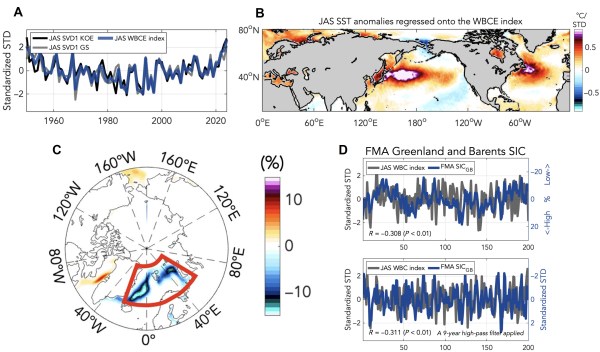
This blog post and the “Deep Dive” podcast, created by NotebookLM, are based on “Evolving synchronization of the Gulf Stream and Kuroshio-Oyashio Extension in a changing climate” by Joh et al. (2026). This research article by Joh et al. (2026) investigates the decadal and seasonal synchronization between two major ocean currents: the Gulf Stream and the Kuroshio-Oyashio Extension. Using historical... Continue Reading →

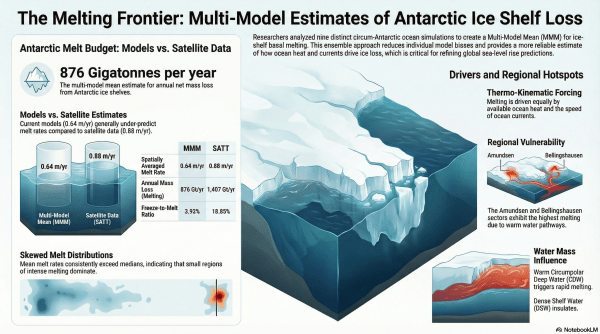
The Great Melt: Uncovering the Hidden Forces Reshaping Antarctica’s Underbelly

This blog post and the “Deep Dive” podcast, created by NotebookLM, are based on “Multi-model estimate of Antarctic ice-shelf basal mass budget and ocean drivers” by Galton-Fenzi et al. (2026). This research paper presents the Realistic Ice Shelf-Ocean Estimates (RISE) Project, which synthesizes nine different numerical simulations to establish a multi-model mean (MMM) of Antarctic... Continue Reading →

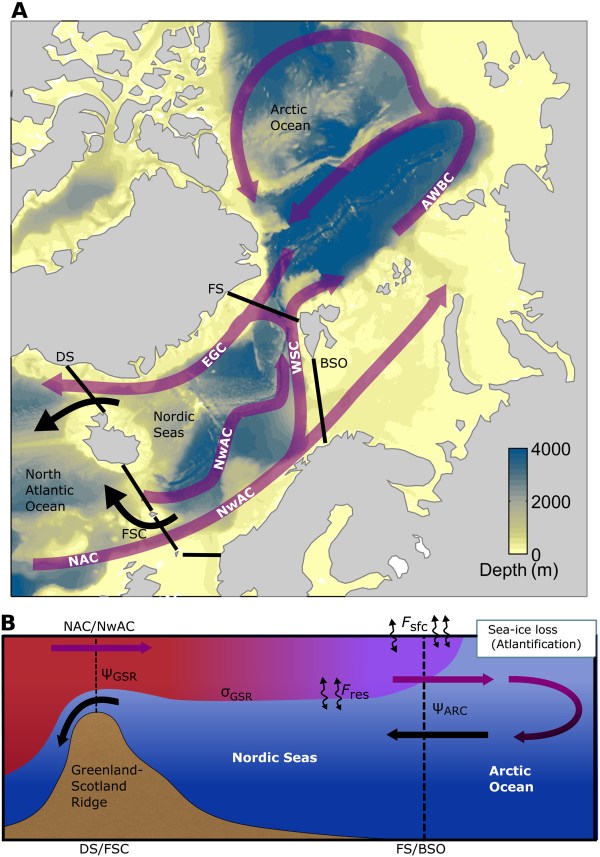
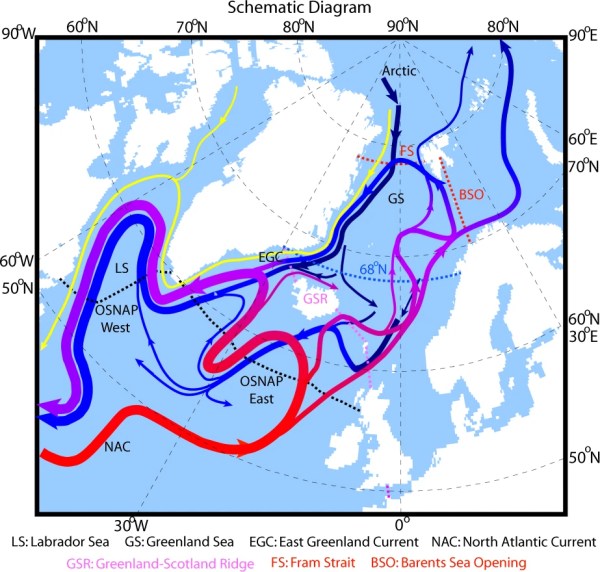
The Arctic’s New Engine: Why the Great Ocean Conveyor Belt is Defying the Warming Trend

This blog post and the “Deep Dive” podcast, created by NotebookLM, are based on “Atlantification drives recent strengthening of the Arctic overturning circulation” by Årthun et al. (2026). A recent study examines how Atlantification, the northward expansion of warm Atlantic waters, is altering the Arctic overturning circulation. While traditional source regions for dense water in the Nordic Seas have... Continue Reading →

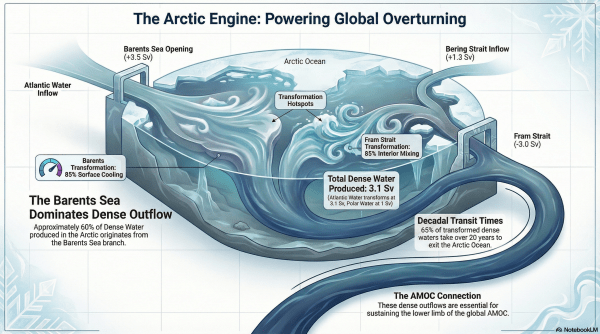
The Barents Sea – Arctic Engine Powering the Global Meridional Overturning Circulation

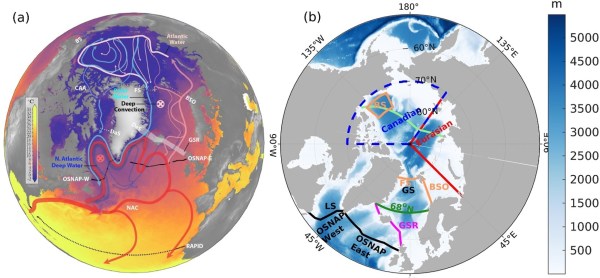
This blog post and the “Deep Dive” podcast, created by NotebookLM, are based on "The Arctic overturning circulation: transformations, pathways and timescales” by Dörr et al. (2026). Dörr et al. (2026) investigates the Arctic overturning circulation by analyzing how warm Atlantic Water is converted into Dense and Polar Waters. Utilizing a high-resolution ocean model and Lagrangian tracking, the authors... Continue Reading →

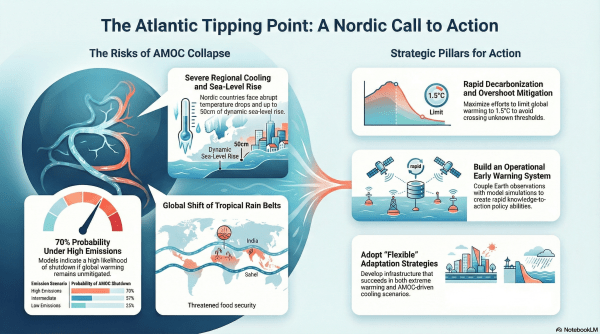
Scientists Urge International Cooperation to Mitigate a Catastrophic AMOC Failure

This blog post and the “Deep Dive” podcast, created by NotebookLM, are based on “A Nordic Perspective on AMOC Tipping: Impacts and Strategies for Prevention and Governance” by Nummelin et al. (2026). For centuries, the North Atlantic has functioned as the Earth’s thermal engine, driven by a "heartbeat" known as the Atlantic Meridional Overturning Circulation... Continue Reading →

Steering the Deep Atlantic Conveyor Belt: The Role of the Eastern Arctic’s Eurasian Basin

This blog post and the “Deep Dive” podcast, created by NotebookLM, are based on “Impacts of eastern Arctic Eurasian Basin water mass properties on the AMOC and Beaufort Sea Atlantic water layer.” by Wei and Zhang (2026). Wei and Zhang (2026) investigates how water mass properties in the eastern Eurasian Basin influence global ocean patterns... Continue Reading →

Four primary “engines” of the Atlantic Meridional Overturning Circulation (AMOC)

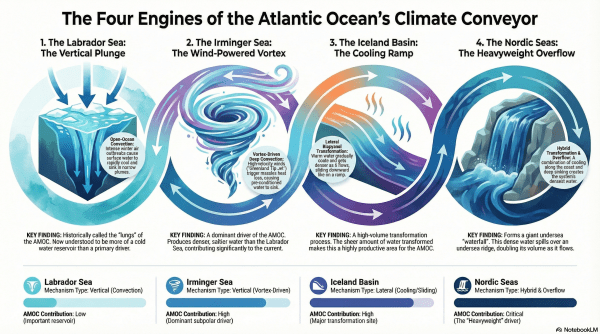
This blog post and the “Deep Dive” podcast, created by Google Gemini Pro and NotebookLM, provide a brief summary of the four primary "engines" of the Atlantic Meridional Overturning Circulation (AMOC) based on Pickart et al. (2003), Chafik & Rossby (2019),, Lozier et al. (2019), Zou et al. (2020), Petit et al. (2020), Chafik et... Continue Reading →

Nordic Seas are the Primary Driver of the AMOC

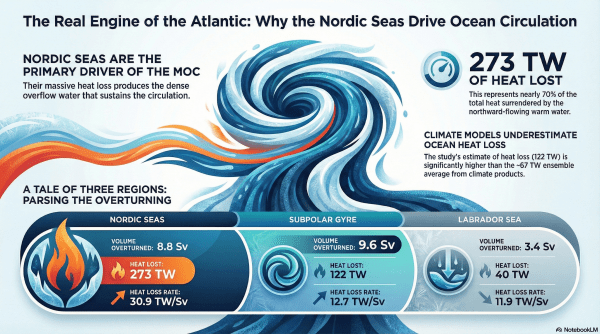
This blog post and the “Deep Dive” podcast, created by NotebookLM, are based on “Volume, Heat, and Freshwater Divergences in the Subpolar North Atlantic Suggest the Nordic Seas as Key to the State of the Meridional Overturning Circulation” by Chafik and Rossby (2019). Research by Chafik and Rossby identifies the Nordic Seas as the primary driver of... Continue Reading →

Outstanding Labrador Sea cooling episodes of the early 1990s remotely increased the Irminger Sea Overturning by 20%

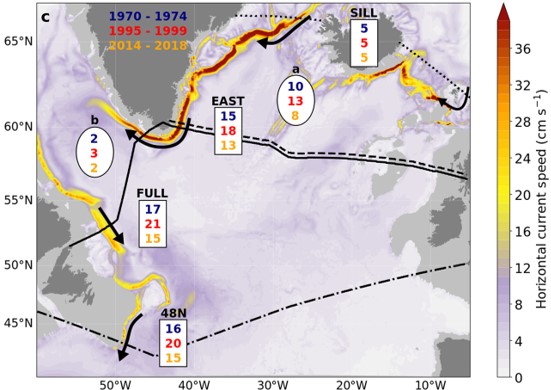
This blog post and the “Deep Dive” podcast, created by NotebookLM, are based on “Decadal changes in Atlantic overturning due to the excessive 1990s Labrador Sea convection” by Böning et al. (2023). Deep beneath the surface of the Atlantic, a colossal current system is constantly at work. Known as the Atlantic Meridional Overturning Circulation (AMOC),... Continue Reading →

While the Labrador Sea contributes little to the AMOC’s strength, it is still the express lane

The recent shift in understanding (the OSNAP results) doesn't mean the Labrador Sea is irrelevant; it just changes its job description. It is less of a "pump" and more of a "conduit" and a "collector." Here is the detailed breakdown of how it works. This blog post was generated by Google Gemini Pro and NotebookLM.... Continue Reading →

Website Powered by WordPress.com.

Up ↑