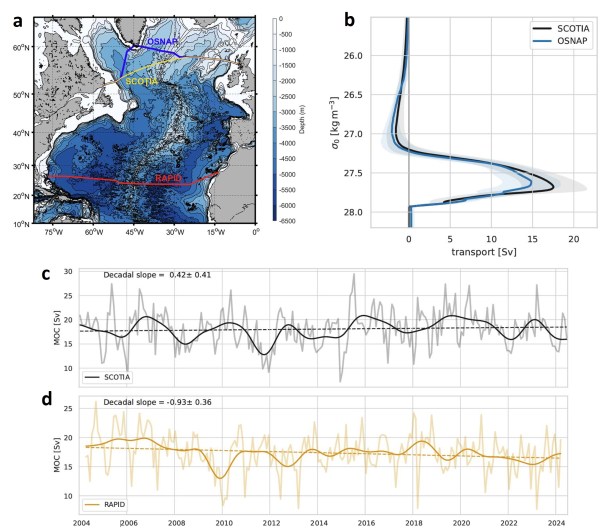
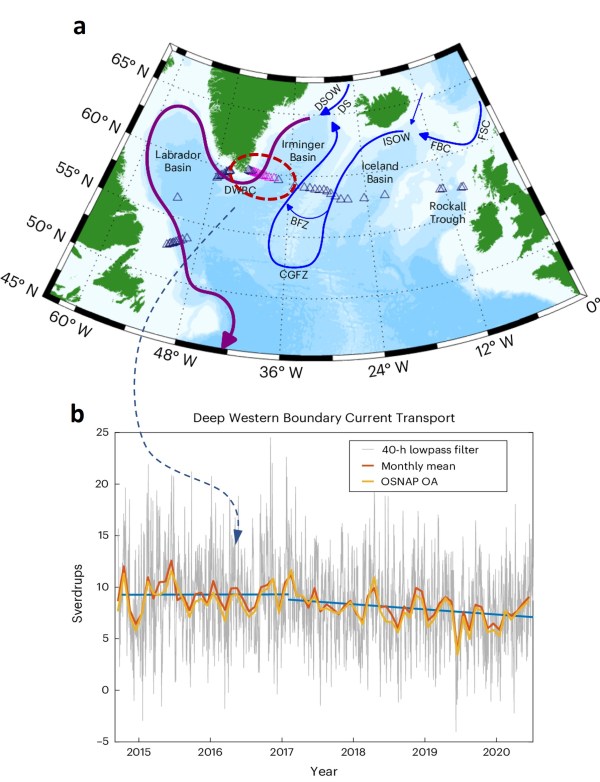
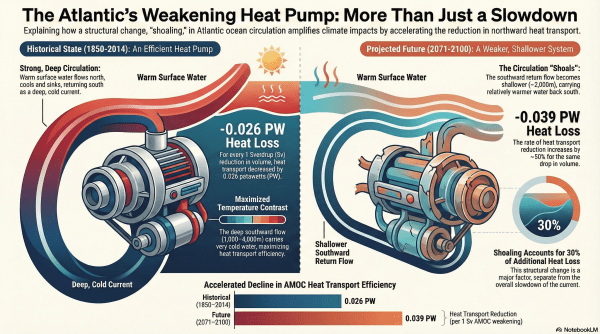
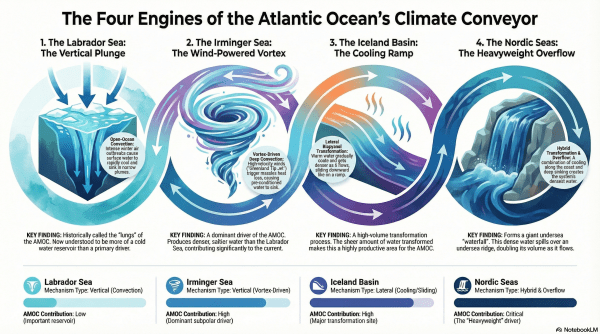
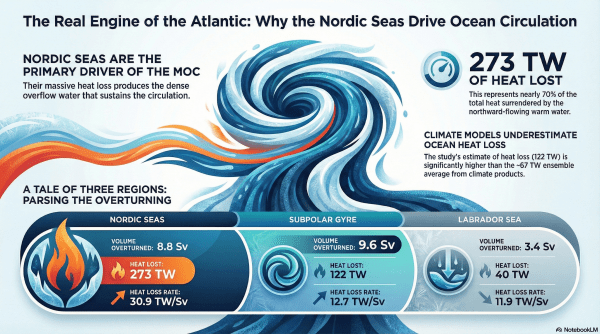
This blog post and the “Deep Dive” podcast on a paper “A pause in the weakening of the Atlantic meridional overturning circulation since the early 2010s” by Lee et al. (2024) was created by NotebookLM. Deep Dive Podcast “Atlantic Current Stability Is Borrowed Time” powered by NotebookLM: Introduction: The Ocean's Alarming Story Just Got More... Continue Reading →
The Atlantic’s Slowing “Heartbeat”: How a Fading Ocean Current Is Silencing a Major Climate Pattern
This blog post and the “Debate” podcast on a paper “Atlantic Meridional Overturning Circulation slowdown suppresses Atlantic Niño variability” by Freire-SouzaLi et al. (2025) was created by NotebookLM. Debate Podcast: This is different from Deep Dive Podcast. This is a debate between two hosts, illuminating different perspectives on the study, “Meltwater or Warming Drives Atlantic... Continue Reading →
The Atlantic’s ‘Warming Hole’ Isn’t What You Think: 5 Surprising Truths From New Climate Research
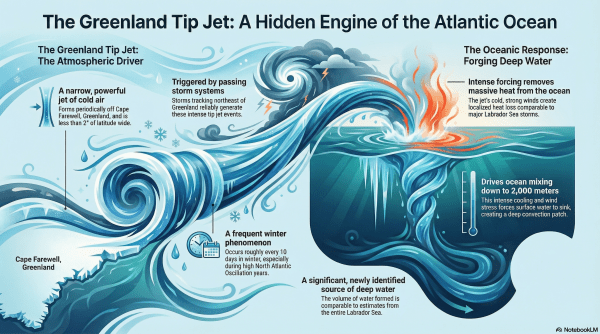
This blog post and the "Deep Drive" podcast on a new paper "Atmosphere-driven processes in shaping long-term climate variability in Greenland and the broader subpolar North Atlantic" by Li et al. (2025) was created by NotebookLM. Deep Dive Podcast "The Wind-Driven Mystery of the North Atlantic Warming Hole: How Atmospheric Swings Orchestrate Ocean Heat and... Continue Reading →
Have you tried NotebookLM for a paper summary?
I usually spend about 10 ~ 20 minutes every morning for literature review before I start my daily routine. Sometimes, a paper looks very interesting, but requires me to spend more than 10 to 15 mins to be able to understand the main takeaway. This is particularly true for those papers with long abstracts and... Continue Reading →
Simulating the AMOC with MOM6 on a $300 Chromebook Plus … and also learning Python
For several years, I have been trying to find time and energy to learn GFDL's Modular Ocean Model version 6 (MOM6), and Python program language. Finally, I have the time and energy to do so. However, I don't have High Performance Computing resources available to me. So, I had no choice but to work on... Continue Reading →
A two-level wind and buoyancy driven thermocline model by Peter Killworth (updated)
I was discussing with my colleagues about a recent northward shift of the Gulf Stream position and debating why that happened. So, I decided to read again one of my favorite physical oceanography papers "A two-level wind and buoyancy driven thermocline model" by the late Dr. Peter D. Killworth. This paper was published in 1985... Continue Reading →
AI’s summary of the signal-to-noise paradox related to the NAO
I asked Gemini (Flash 2.5) about the signal-to-noise paradox regarding the North Atlantic Oscillation, which is one of the emerging new ideas (or concepts) in climate research. Here is the reply. Yes, I am familiar with the signal-to-noise paradox, especially as it relates to the North Atlantic Oscillation (NAO). It's a significant and intriguing challenge... Continue Reading →
A note on the potential AMOC collapse for nonexperts
As the Earth warms due to anthropogenic climate change, sea- and land-based ice melts, adding buoyant freshwater to the surface of the high-latitude North Atlantic and thus decreasing salinity. This makes the surface water lighter reducing the sinking of the surface water and thus the AMOC. However, the amount of added freshwater is not enough... Continue Reading →
Human-induced weakening of the AMOC averted for now
The current state-of-the-art climate models suggest that the human-induced weakening of the Atlantic Meridional Overturning Circulation (AMOC) has already begun since the mid-1980s. However, continuous direct observational records during the past two decades have shown no clear sign of a slowing down of the AMOC. To shed light on this apparent contradiction, a new study... Continue Reading →
The annual mean AMOC in 2022 is the lowest after its biggest drop in 2009
Scientists have been monitoring the Atlantic Meridional Overturning Circulation (AMOC) at around 26.5°N since April 2004 through the RAPID/Meridional Overturning Circulation and Heatflux Array/Western Boundary Time Series moored array (RAPID). The newly released RAPID dataset fully incorporated a recent geomagnetic correction of the submarine cable measurement of the Florida Current transport, a critical component of... Continue Reading →