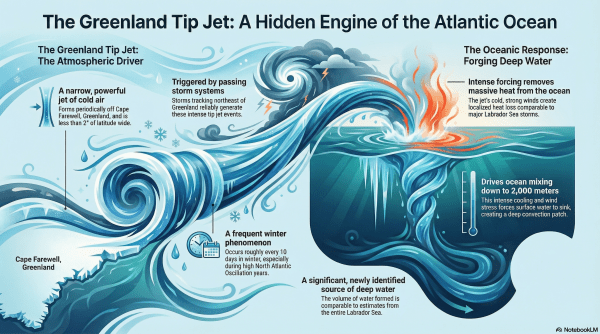
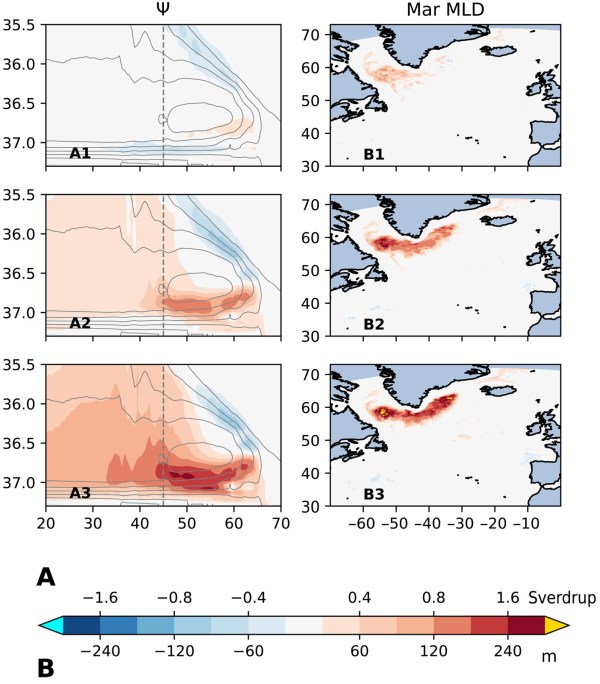
This blog post and the “Deep Dive” podcast, created by NotebookLM, are based on “Deep convection in the Irminger Sea forced by the Greenland tip jet.” by Pickart et al. (2003). This research by Pickart et al. (2003) identified the Greenland tip jet as the primary driver of deep ocean convection in the southwest Irminger... Continue Reading →
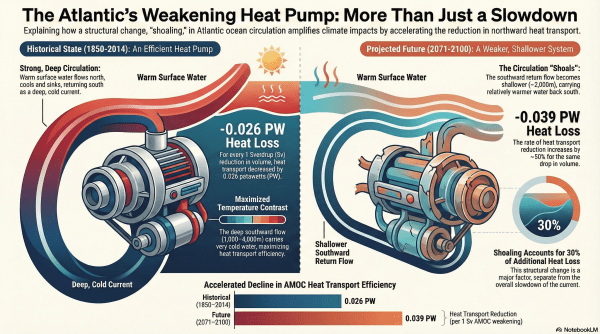
A Stalling Engine: How “Shoaling” of the Ocean’s Conveyor Belt Accelerates the Decline of Ocean Heat Transport
This blog post and the “Deep Dive” podcast, created by NotebookLM, are based on “Future Shoaling of the AMOC and Its Impact on Oceanic Heat Transport to the Subpolar North Atlantic” by Lee et al. (2026). Research by Lee et al. (2026) investigates how greenhouse gas emissions will alter the Atlantic Meridional Overturning Circulation (AMOC) and its ability to move heat... Continue Reading →
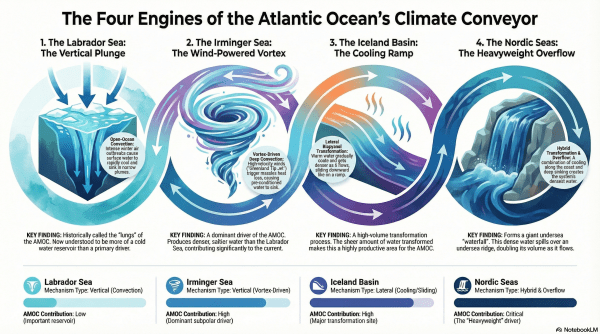
Four primary “engines” of the Atlantic Meridional Overturning Circulation (AMOC)
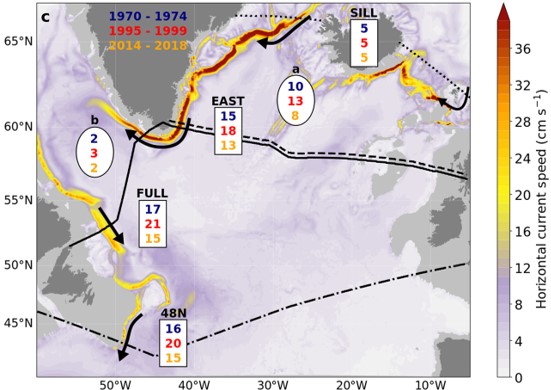
This blog post and the “Deep Dive” podcast, created by Google Gemini Pro and NotebookLM, provide a brief summary of the four primary "engines" of the Atlantic Meridional Overturning Circulation (AMOC) based on Pickart et al. (2003), Chafik & Rossby (2019),, Lozier et al. (2019), Zou et al. (2020), Petit et al. (2020), Chafik et... Continue Reading →
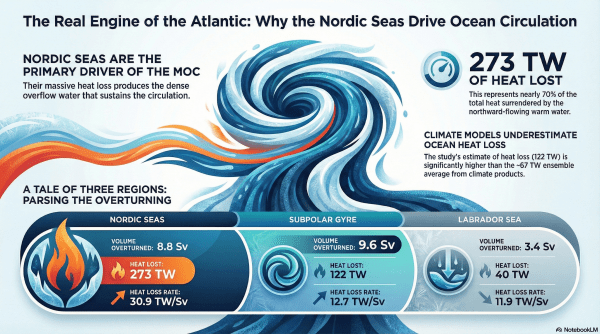
Nordic Seas are the Primary Driver of the AMOC
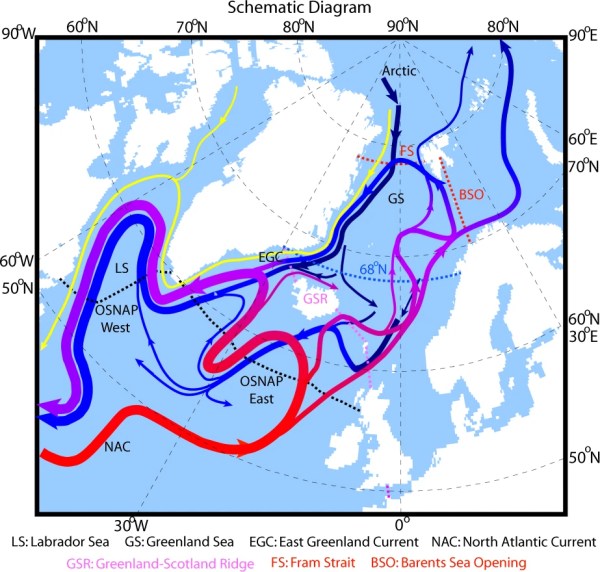
This blog post and the “Deep Dive” podcast, created by NotebookLM, are based on “Volume, Heat, and Freshwater Divergences in the Subpolar North Atlantic Suggest the Nordic Seas as Key to the State of the Meridional Overturning Circulation” by Chafik and Rossby (2019). Research by Chafik and Rossby identifies the Nordic Seas as the primary driver of... Continue Reading →
The Tail Wags the Dog: How the ‘Quiet’ Labrador Sea Sets the Rhythm for a Critical Atlantic Current
This blog post and the “Deep Dive” podcast, created by NotebookLM, are based on “An outsized role for the Labrador Sea in the multidecadal variability of the Atlantic overturning circulation” by Yeager et al. (2021). This research article by Yeager et al. (2021) utilizes high-resolution climate simulations to investigate the Labrador Sea's influence on long-term... Continue Reading →
Oceanic Slow-Lane: Why the Subtropical Gyre Holds the Key to How the ITCZ Responds to AMOC Slowdown
This blog post, created by NotebookLM, is based on “On the Atlantic extratropical-tropical teleconnection in response to external freshwater forcing” by Joshi an Zhang (2026). This research study utilizes a coupled climate model to investigate how a massive influx of freshwater in the North Atlantic triggers a chain reaction that shifts the Intertropical Convergence Zone (ITCZ) southward. The authors demonstrate that... Continue Reading →
Outstanding Labrador Sea cooling episodes of the early 1990s remotely increased the Irminger Sea Overturning by 20%
This blog post and the “Deep Dive” podcast, created by NotebookLM, are based on “Decadal changes in Atlantic overturning due to the excessive 1990s Labrador Sea convection” by Böning et al. (2023). Deep beneath the surface of the Atlantic, a colossal current system is constantly at work. Known as the Atlantic Meridional Overturning Circulation (AMOC),... Continue Reading →
While the Labrador Sea contributes little to the AMOC’s strength, it is still the express lane
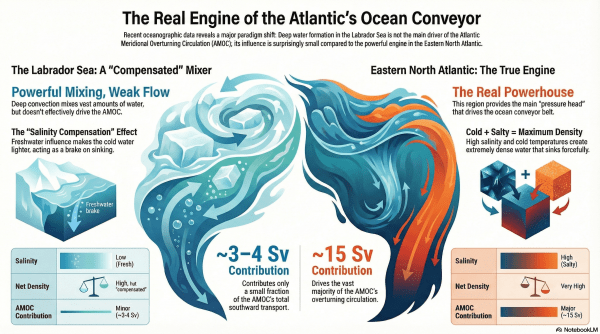
The recent shift in understanding (the OSNAP results) doesn't mean the Labrador Sea is irrelevant; it just changes its job description. It is less of a "pump" and more of a "conduit" and a "collector." Here is the detailed breakdown of how it works. This blog post was generated by Google Gemini Pro and NotebookLM.... Continue Reading →
Convection ≠ Overturning: Why Labrador Sea Convection Doesn’t Drive The AMOC
The oceanographic community is currently re-evaluating the Labrador Sea's role in maintaining the Atlantic Meridional Overturning Circulation (AMOC). While historical estimates suggested a contribution of up to 9 Sv (Böning et al., 1996; Mauritzen and Häkkinen, 1999; Talley, 2003; Brandt et al., 2007), recent data from the Overturning in the Subpolar North Atlantic Program (OSNAP)... Continue Reading →
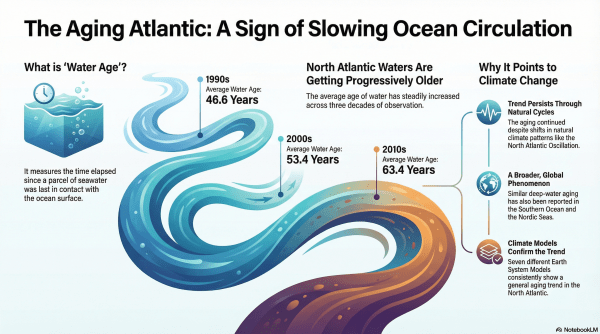
North Atlantic Ocean Is Aging Fast And Losing Its Breath
This blog post and the “Deep Dive” podcast, created by NotebookLM, are based on “North Atlantic ventilation change over the past three decades is potentially driven by climate change” by Guo et al. (2026). A new study suggests that seawater in the North Atlantic is aging, a phenomenon that indicates a slowdown in ocean ventilation over the last... Continue Reading →