The annual mean AMOC in 2022 is the lowest after its biggest drop in 2009
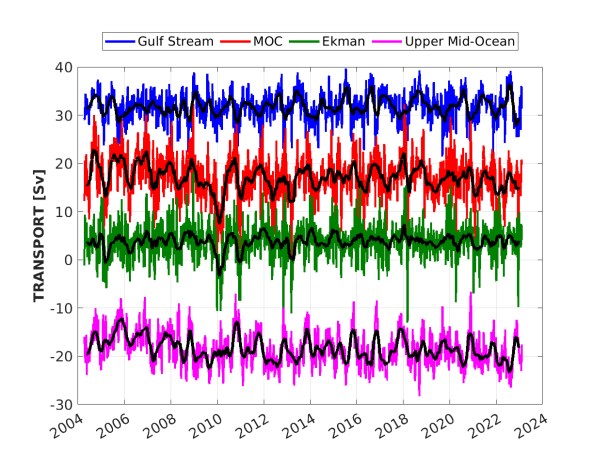
Scientists have been monitoring the Atlantic Meridional Overturning Circulation (AMOC) at around 26.5°N since April 2004 through the RAPID/Meridional Overturning Circulation and Heatflux Array/Western Boundary Time Series moored array (RAPID). The newly released RAPID dataset fully incorporated a recent geomagnetic correction of the submarine cable measurement of the Florida Current transport, a critical component of... Continue Reading →

France’s floating ocean laboratory is a future hub of international Arctic research collaboration

As of 2024, there are currently 70 permanent research stations from 29 countries scattered around the continent of Antarctica conducting important scientific research to better understand the Earth system and its changes due to human activity. In the Arctic, however, there are no such permanent research stations because there is no land in the Arctic.... Continue Reading →

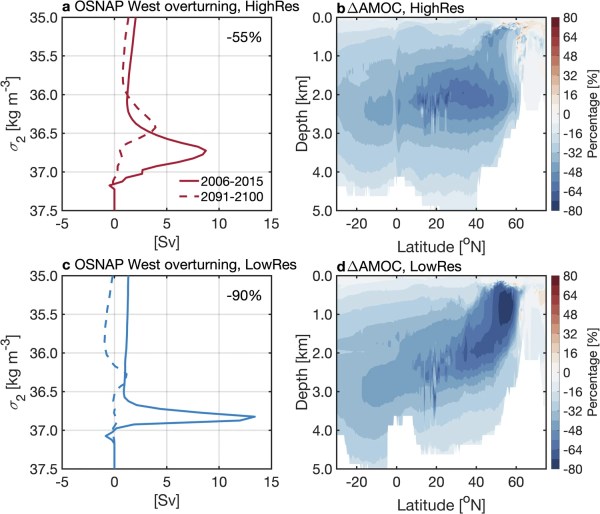
The Labrador Current restricts the Arctic freshwater-induced weakening of the AMOC

The Labrador Sea is one of the main regions where the surface Atlantic water loses its heat to the atmosphere (thus gets heavier) and sinks into the deep ocean, producing what's known as deep ocean convection that mainly drives the Atlantic Meridional Ocean Circulation (AMOC). It is also characterized by the Labrador Current, a strong... Continue Reading →

Geomagnetic correction of submarine cable measurement revealed no significant trend in the Gulf Stream transport since 1982

The Florida Current (FC) refers to the Gulf Stream across the Florida Straits between Florida and the Bahamas. Its volume transport has been measured continuously since 1982 using submarine cables across the Florida Straits at 27°N by NOAA's Atlantic Oceanographic and Meteorological Laboratory (AOML). A previous study (Piecuch and Beal, 2023) reported that the FC... Continue Reading →

Website Powered by WordPress.com.

Up ↑